Your 'Free Consultation' Offer May Breach Guidelines

Reviewed by Dr Hercules Kollias, AHPRA-registered practitioner · 30 years clinical experience
Who this applies to: Cosmetic injectors, dermal therapists, cosmetic surgeons, dentists offering cosmetic dentistry, physiotherapists, chiropractors, and any AHPRA-registered practitioner advertising consultations, assessments, or initial appointments for regulated health services
- Free consultations are legally permissible, but marketing them with monetary value emphasis, urgency language, or scarcity tactics transforms them into prohibited inducements under AHPRA Guidelines Section 3.7
- Phrases like "valued at $150", "limited spots available", "this week only", or "save $200" create pressure to access services rather than informing patients about availability
- The compliance test is whether the offer encourages informed decision-making or creates commercial pressure — even genuinely no-cost services breach guidelines when framed as inducements
- Penalties reach $60,000 per offence for individual practitioners and $120,000 for corporate entities under the 2022 amendments to the National Law
Are free consultation offers allowed under AHPRA guidelines?
Yes, but only when presented as factual service information without commercial pressure tactics. AHPRA Guidelines Section 3.7 permits no-charge consultations when advertised neutrally, but prohibits framing them with monetary value emphasis, urgency language, scarcity claims, or any element that pressures patients to access services rather than make informed healthcare decisions.
The distinction is critical and frequently misunderstood across the Australian cosmetic and healthcare sectors. A simple statement like "Initial consultations are provided at no charge" complies with AHPRA's advertising guidelines. However, framing the same offer as "FREE consultation — valued at $150! Limited spots this month!" creates multiple compliance violations.
The regulatory framework focuses on inducements that encourage indiscriminate or unnecessary use of regulated health services. In plain English, this means AHPRA prohibits marketing tactics that push patients toward accessing healthcare based on commercial appeal rather than clinical need. The test is whether your advertising promotes informed patient choice or creates commercial pressure to book an appointment.
This applies across all platforms where practitioners advertise: Instagram posts, Facebook ads, website homepage banners, Google Ads campaigns, email marketing, practice signage, and third-party booking platforms. The medium doesn't change the compliance obligation — the framing and language determine whether an offer constitutes a prohibited inducement.
What specific language makes free consultation offers non-compliant?
Monetary value statements ("valued at $150", "save $200"), urgency language ("limited time", "this week only", "expires soon"), scarcity claims ("only 5 spots left", "limited availability"), and pressure phrases ("don't miss out", "exclusive offer") all transform legitimate no-charge services into prohibited inducements by emphasising commercial benefit over clinical appropriateness.
AHPRA's position centres on whether the advertising creates pressure or encourages unnecessary use of services. When you emphasise what patients "save" rather than what clinical value the consultation provides, you shift the focus from healthcare decision-making to commercial transaction.
These common promotional phrases breach AHPRA Guidelines Section 3.7:
- "FREE skin consultation — normally $150, yours at no cost!"
- "Complimentary assessment (valued at $200) — limited spots available"
- "Book your free consultation this week — offer ends Friday!"
- "Save $180 on your initial appointment — new clients only"
- "Exclusive: Free cosmetic consultation for the first 10 callers"
- "Don't miss out — complimentary treatment planning session (worth $120)"
Each of these examples includes elements that create commercial pressure. The monetary value emphasis suggests patients should access the service because of financial benefit rather than clinical need. Urgency language and artificial scarcity create time pressure that discourages considered decision-making. Terms like "exclusive" and "don't miss out" frame healthcare access as a competitive commercial opportunity.
The regulatory concern is that these tactics may lead patients to access consultations they don't need, or to make treatment decisions based on promotional pressure rather than informed clinical discussion. This is particularly relevant for cosmetic procedures, where the line between healthcare and commercial service can already be ambiguous.
Practitioners often argue that competitors use identical language without consequences. This is not a defence. AHPRA operates on a complaints-driven enforcement model — the absence of current penalties doesn't indicate compliance, it indicates the absence of complaints to date. When complaints are lodged, AHPRA reviews advertising against current guidelines regardless of how long the content has been published or how many other practitioners use similar language.
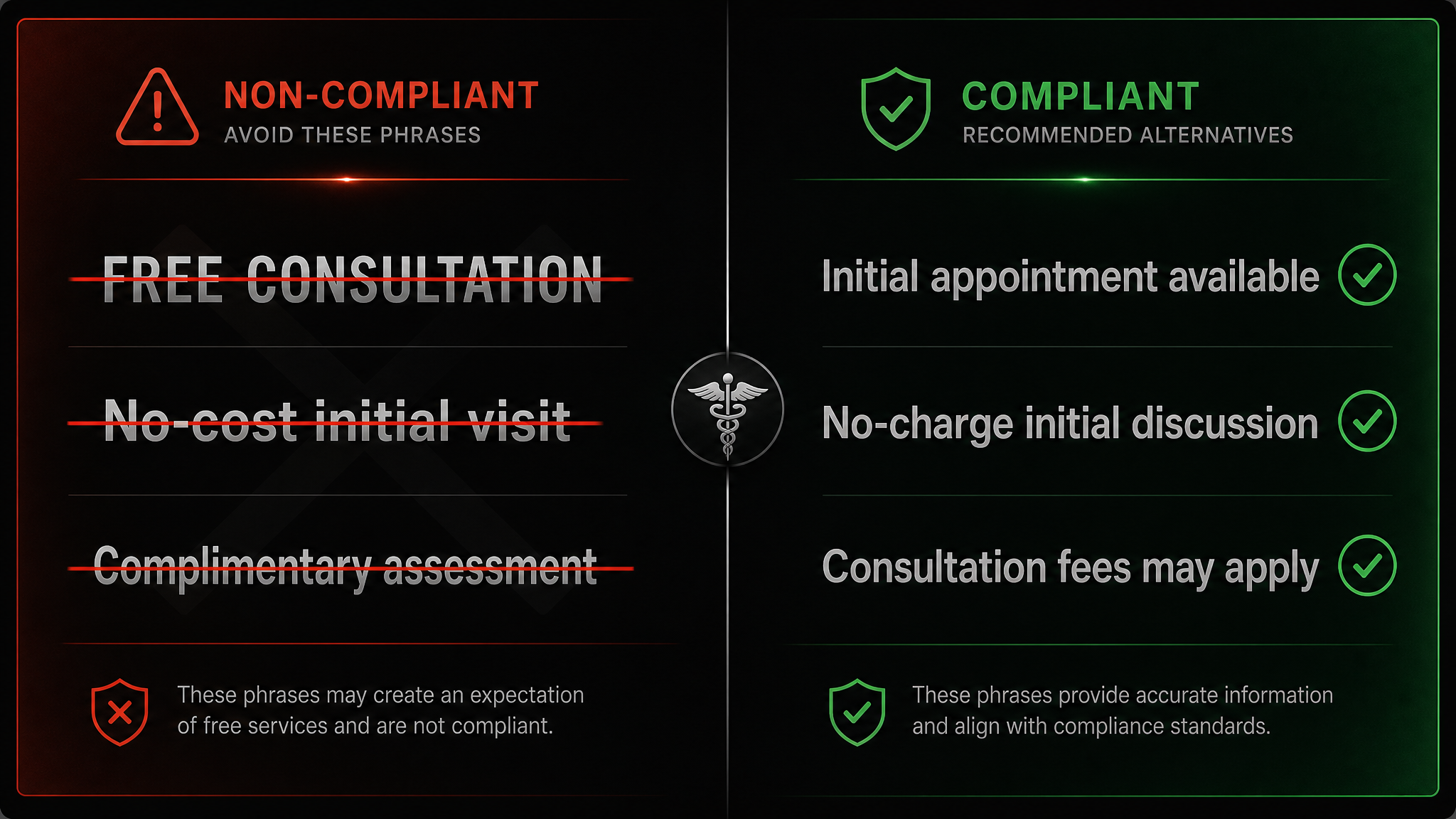
How should practitioners advertise no-charge consultations compliantly?
Use factual, neutral language that informs patients about service availability without commercial emphasis. State that consultations are provided at no charge, explain what the consultation involves clinically, and focus on facilitating informed decision-making rather than creating urgency or emphasising financial benefit. Avoid any language that could pressure patients to access services.
Compliant advertising centres on clinical information and patient education. The consultation should be presented as a standard part of your clinical process — an opportunity for assessment, discussion of suitability, explanation of risks and benefits, and informed consent — rather than as a promotional offer or limited-time opportunity.
These approaches align with AHPRA Guidelines Section 3.7:
- "Initial consultations are provided at no charge to discuss your concerns and treatment suitability"
- "We offer complimentary consultations to assess whether treatment is appropriate for your individual circumstances"
- "Your first appointment includes a comprehensive assessment at no cost, allowing time to discuss options and answer questions"
- "Consultations are available without charge to ensure you have the information needed to make an informed decision"
- "We provide no-charge initial consultations as part of our commitment to informed patient care"
Notice that these examples focus on clinical process, patient education, and informed decision-making. They explain what the consultation involves and why it's offered, without creating commercial pressure or emphasising financial benefit. The no-charge aspect is stated factually rather than promoted as a limited opportunity or money-saving offer.
This approach aligns with the broader regulatory framework around cosmetic procedure advertising. The September 2025 updates to AHPRA's cosmetic surgery advertising guidelines emphasise that all advertising must be transparent, factual, and educational rather than persuasive or sensational. This principle applies equally to consultation offers — the advertising should facilitate informed healthcare decisions, not drive commercial bookings through promotional tactics.
For practitioners concerned about competitive disadvantage, remember that compliant advertising can still be effective marketing. Emphasising your clinical expertise, explaining your assessment process, and demonstrating commitment to patient safety and informed consent builds trust and attracts patients seeking quality care rather than promotional deals. This typically results in higher-quality patient relationships and better clinical outcomes.
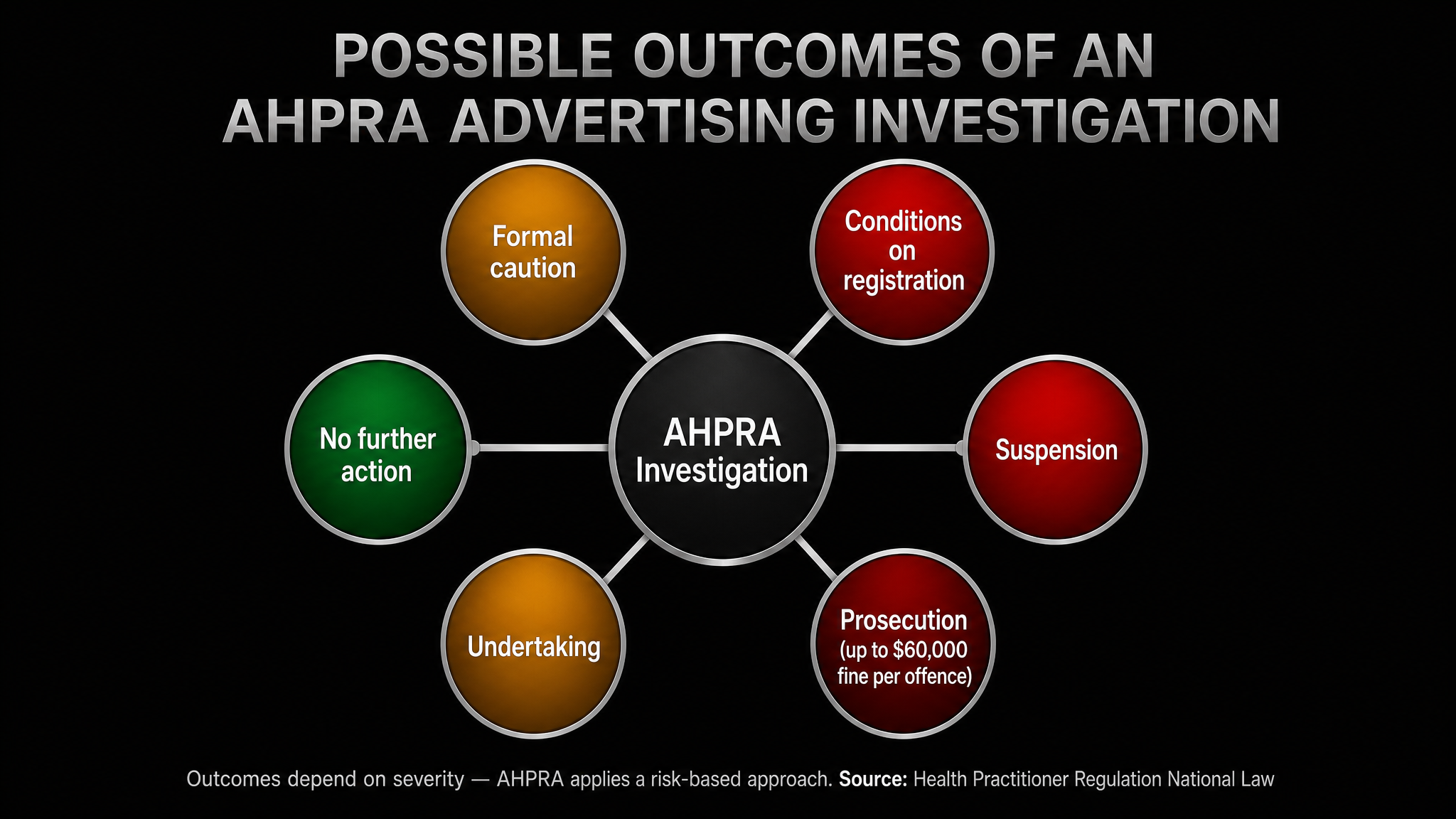
What penalties apply for non-compliant consultation advertising?
Individual practitioners face penalties up to $60,000 per offence, while bodies corporate face penalties up to $120,000 per offence under the Health Practitioner Regulation National Law as amended in 2022. Each instance of non-compliant advertising constitutes a separate offence, meaning multiple platforms or repeated posts can result in cumulative penalties exceeding these individual offence maximums.
Under the Health Practitioner Regulation National Law (as amended 2022):
- Individual practitioners: up to $60,000 per offence
- Bodies corporate: up to $120,000 per offence
Source: Health Practitioner Regulation National Law and Other Legislation Amendment Act 2022
These penalty figures represent a doubling from the previous maximum penalties of $30,000 for individuals and $60,000 for corporations. The 2022 amendments to the National Law reflect increased regulatory focus on health advertising compliance, particularly in the cosmetic and aesthetic medicine sectors where advertising violations have been most prevalent.
The "per offence" structure is significant. If you advertise a non-compliant free consultation offer on your website homepage, Instagram feed, Facebook page, and Google Ads campaign, AHPRA can treat each platform as a separate offence. If the Instagram post remains published for multiple months, ongoing publication can constitute continuing offences. This means total penalties can substantially exceed the single-offence maximums.
Beyond financial penalties, AHPRA can impose conditions on registration, require mandatory education, issue cautions or reprimands, or in serious cases, suspend or cancel registration. For corporate entities operating cosmetic clinics, the reputational damage from public disciplinary findings can impact patient trust and business viability more significantly than the financial penalties themselves.
Enforcement is complaints-driven but increasingly proactive. AHPRA conducts targeted compliance sweeps of cosmetic procedure advertising, particularly on social media platforms where violations are most common. The regulator has specifically identified inducement-based advertising as a priority enforcement area. Practitioners cannot rely on the absence of past enforcement action as evidence of compliance — regulatory priorities and enforcement intensity change over time.
It's also important to understand that AHPRA penalties operate separately from potential Australian Consumer Law violations. If your consultation advertising is also found to be misleading or deceptive under Section 18 of the Australian Consumer Law, additional penalties up to $2,500,000 for individuals or $50,000,000 for corporations can apply. While this level of penalty is typically reserved for serious, large-scale violations, the regulatory exposure extends beyond AHPRA's jurisdiction alone.
Do inducement rules apply to package deals and bundled consultations?
Yes. Advertising treatment packages that include "free" or "complimentary" consultations as part of bundled pricing creates the same inducement concerns when marketed with value emphasis or pressure tactics. The consultation component must not be promoted as an added-value inducement to purchase treatment packages, and the overall package advertising must not create pressure to access services.
Many cosmetic practitioners offer treatment packages — for example, "Three sessions of laser treatment including initial consultation and follow-up assessment". This is clinically appropriate and can be advertised, but the framing matters significantly for compliance.
Non-compliant package advertising typically emphasises the consultation's included value: "Treatment package includes FREE consultation (valued at $150) plus three laser sessions — total value $1,200, package price $899". This creates multiple compliance issues. It emphasises monetary savings, uses the consultation as an inducement to purchase the treatment package, and frames healthcare services as a commercial transaction focused on value rather than clinical appropriateness.
Compliant package advertising focuses on clinical process and treatment planning: "Treatment packages include comprehensive initial consultation and assessment to ensure suitability, followed by three treatment sessions with ongoing clinical review". This describes what's included without creating commercial pressure or emphasising financial benefit.
Myth: If the consultation is genuinely provided at no separate charge as part of a treatment package, advertising it as "free" or "included" is always compliant.
Reality: Even when consultations genuinely have no separate charge, advertising them as "free" or emphasising their included value can constitute a prohibited inducement if it creates commercial pressure to purchase the package. The compliance test is whether the advertising encourages informed decision-making or creates pressure to access services based on promotional appeal.
This distinction is particularly important for cosmetic injectors and aesthetic practitioners who commonly offer package deals for treatments requiring multiple sessions. The consultation is a clinical necessity for proper patient assessment and informed consent — it should be presented as a standard clinical process, not as a value-added promotional benefit.
The same principles apply to loyalty programs, membership models, and subscription-based service offerings. If your practice offers a membership that includes "unlimited complimentary consultations", this can be advertised factually without emphasising the monetary value saved or creating pressure to join based on promotional benefit rather than clinical value.
For practitioners concerned about how to communicate package value without breaching inducement provisions, focus on clinical outcomes, practitioner expertise, and treatment quality rather than financial savings. Patients seeking cosmetic procedures based primarily on promotional value rather than clinical suitability represent higher risk for dissatisfaction, complications, and complaints — the very outcomes AHPRA's inducement provisions aim to prevent.
What about Google reviews mentioning free consultations?
Patient reviews on platforms you control (Google Business Profile, Facebook reviews on your practice page, website testimonial sections) that mention free consultations constitute testimonial content prohibited under Section 133 of the National Law. You must actively moderate and remove such content, as AHPRA holds practitioners responsible for testimonial material appearing on platforms they control, regardless of who authored it.
This creates a dual compliance issue. First, any patient review or testimonial is prohibited in advertising for regulated health services under Section 133. In plain English, this means you cannot use patient feedback, reviews, ratings, or testimonials in any form in your advertising, including on platforms like Google Business Profile that you control through practice ownership or management.
Second, if those reviews specifically mention free consultations or promotional offers, they can constitute evidence of inducement-based advertising. A review stating "Great experience! They offer free consultations which was so helpful" serves as public evidence that you're promoting free consultations in a way that influences patient behaviour — exactly what inducement provisions aim to regulate.
AHPRA's position is clear: practitioners must actively monitor and remove testimonial content from platforms they control. You cannot defend non-compliance by arguing that patients posted the content independently. For Google reviews and AHPRA compliance, this means either disabling reviews entirely on your Google Business Profile or implementing active moderation to remove testimonial content as it appears.
The practical challenge is that Google Business Profile reviews cannot be selectively removed by business owners — you can only flag inappropriate content for Google's review, and Google determines whether to remove it based on their own policies, which don't align with AHPRA's testimonial prohibition. This is why many compliant practitioners choose to disable Google reviews entirely, despite the potential impact on local search visibility.
For platforms where you have direct content control — your practice website, Facebook page content, Instagram posts and comments — you must actively moderate and remove any patient testimonials, including those mentioning free consultations or other promotional aspects of your service. This extends to comments on your social media posts: if patients comment praising your free consultation offer, those comments constitute testimonial content you must remove.
Third-party review platforms you don't control (such as independent healthcare review sites where you haven't claimed a business profile) present a different situation. You're generally not held responsible for content on platforms you don't control or benefit from. However, if you link to these reviews, embed them on your website, or otherwise incorporate them into your advertising, they become part of your advertising material and must comply with all applicable guidelines.
How can practitioners audit existing consultation advertising for compliance?
Review all platforms where your practice advertises — website, social media profiles, Google Business Profile, paid advertising, email campaigns, and practice signage. Identify any language emphasising monetary value, creating urgency, implying scarcity, or framing consultations as limited offers. Replace this language with factual, neutral descriptions of your consultation process focused on clinical assessment and informed decision-making.
A systematic audit should cover every patient touchpoint where consultation information appears. Start with your website homepage and service pages — these are typically the primary advertising channels and often contain the most prominent consultation offers. Look for banner graphics, call-to-action buttons, and promotional sections that emphasise free consultations with value language or urgency tactics.
- Website: Homepage banners, service pages, booking pages, pop-ups, footer content
- Social Media: Instagram bio, pinned posts, story highlights, Facebook page "About" section, LinkedIn profile
- Paid Advertising: Google Ads campaigns, Facebook/Instagram ads, display advertising
- Email Marketing: Welcome sequences, promotional campaigns, newsletter content
- Google Business Profile: Business description, posts, offers section
- Third-Party Platforms: Booking platforms, directory listings, aggregator sites
- Physical Materials: Practice signage, brochures, business cards, consultation room materials
- Staff Scripts: Phone answering scripts, reception desk language, booking confirmation messages
For each instance where consultations are mentioned, apply the compliance test: Does this language inform patients about clinical process and facilitate informed decision-making, or does it create commercial pressure to book based on promotional appeal? If the language emphasises what patients save, creates urgency, or frames the consultation as a limited opportunity, it requires revision.
Pay particular attention to social media advertising, where inducement-based language is most common and where AHPRA enforcement activity has been concentrated. Instagram posts, Facebook ads, and TikTok content frequently use urgency language and value emphasis because these tactics drive engagement and bookings. The commercial effectiveness of these tactics is precisely why they're prohibited — they encourage access to healthcare services based on promotional pressure rather than clinical need.
For practices with multiple practitioners or locations, ensure consistency across all advertising channels. A single non-compliant Instagram post from one practitioner can create regulatory exposure for the entire corporate entity. Implement clear advertising guidelines for all practitioners and staff members who create patient-facing content, and establish approval processes for any advertising material before publication.
Consider using an AHPRA advertising compliance checker to systematically review your content before publication. Automated compliance tools can identify high-risk language patterns and regulatory violations across large volumes of content more efficiently than manual review, though they should complement rather than replace professional regulatory understanding.
For ongoing compliance, implement regular audits — quarterly reviews of all advertising channels ensure that new content, updated promotional campaigns, and evolving social media strategies maintain compliance as your practice grows and marketing approaches change. Compliance is not a one-time project but an ongoing operational requirement.
What should practices do if they've already advertised non-compliant offers?
Immediately remove or revise all non-compliant advertising across every platform. Document the changes made and the dates of removal. If you've received patient bookings based on non-compliant advertising, you must still honour those consultations, but cease all further promotion using prohibited language. Proactive correction substantially reduces enforcement risk if complaints are subsequently lodged.
The most critical step is immediate cessation of non-compliant advertising. Do not wait to revise messaging or develop new creative assets — remove the problematic content first, then replace it with compliant alternatives. Every additional day non-compliant advertising remains published represents ongoing regulatory exposure and potential additional offences.
For website content, update pages immediately and clear any cached versions. For social media, delete non-compliant posts rather than editing them (editing preserves the original publication date, while deletion removes the content entirely). For paid advertising campaigns on Google, Facebook, or other platforms, pause campaigns immediately and revise ad copy before resuming.
Document your compliance remediation process. Keep records of what content was removed, when it was removed, and what compliant alternatives were implemented. If AHPRA subsequently investigates based on a complaint, evidence of proactive compliance action demonstrates good faith and can influence enforcement decisions. While it doesn't eliminate regulatory exposure for past violations, it substantially reduces the likelihood of maximum penalties.
For Google Business Profile content, remove any posts or offers advertising free consultations with prohibited language. Update your business description to remove value emphasis or urgency language. If you've created a specific "offer" in Google Business Profile promoting free consultations, delete it entirely.
If you've sent email marketing campaigns with non-compliant consultation offers, you cannot recall those emails, but you should send a follow-up message with corrected information if the original campaign included time-limited offers or urgency language that might pressure recipients to book quickly. For future email campaigns, implement compliance review before sending.
- Audit all platforms where your practice advertises to identify non-compliant consultation offers
- Remove or revise all content containing monetary value emphasis, urgency language, or scarcity claims
- Document changes including dates of removal and screenshots of original vs. revised content
- Implement review processes to prevent future non-compliant advertising from being published
- Train all staff who create patient-facing content on inducement compliance requirements
- Schedule regular compliance audits to ensure ongoing adherence to AHPRA guidelines
For practices that have built significant marketing campaigns around free consultation offers, this may require substantial revision of marketing strategy. However, the regulatory risk of continuing non-compliant advertising far exceeds the commercial inconvenience of revising your approach. Practitioners facing AHPRA penalties and potential registration conditions experience far greater business disruption than those who proactively correct advertising compliance issues.
If you're uncertain whether specific content complies, err on the side of caution and revise it. The compliance test is whether advertising could create pressure to access services based on commercial appeal rather than clinical need. If you're unsure, the content likely requires revision. For complex cases or high-stakes advertising campaigns, consider professional compliance review before publication.
Remember that compliance is not just about avoiding penalties — it's about ensuring your advertising promotes informed patient decision-making and appropriate use of healthcare services. Patients who book consultations based on promotional pressure rather than genuine clinical need are more likely to be dissatisfied, less likely to proceed with appropriate treatment, and more likely to lodge complaints. Compliant advertising typically results in better-quality patient relationships and better clinical outcomes.
- AHPRA Advertising Guidelines — Section 3.7 (Inducements), updated March 2020 with September 2025 cosmetic procedure amendments
- Health Practitioner Regulation National Law — Section 133 (Advertising offences including testimonials and inducements), as amended 2022
- AHPRA Cosmetic Procedure Advertising Guidelines — Updated September 2025 with enhanced requirements for higher-risk cosmetic procedures
Regulations verified current as of 02 June 2026.
This article is for educational purposes only and does not constitute legal or medical advice. Practitioners should consult their legal adviser or AHPRA directly for guidance specific to their circumstances.
Dr Hercules Kollias
AHPRA-registered practitioner · 30 years clinical experience
Founder, The Compliance Scalpel
Dr Kollias built The Compliance Scalpel after three decades of clinical practice — encoding hard-won knowledge of AHPRA and TGA advertising rules into automated compliance tooling for Australian healthcare practitioners.
Check Before You Publish
The Compliance Scalpel audits your healthcare marketing content against AHPRA and TGA guidelines before it goes live. Catch the risks. Cut them out.
Try the Scalpel