Your Google Reviews May Trigger AHPRA Penalties
Reviewed by Dr Hercules Kollias, AHPRA-registered practitioner · 30 years clinical experience
Who this applies to: Cosmetic injectors, dermal therapists, registered nurses providing cosmetic injectable treatments, medical practitioners offering aesthetic procedures, and any AHPRA-registered practitioner advertising cosmetic services including prescription injectable treatments
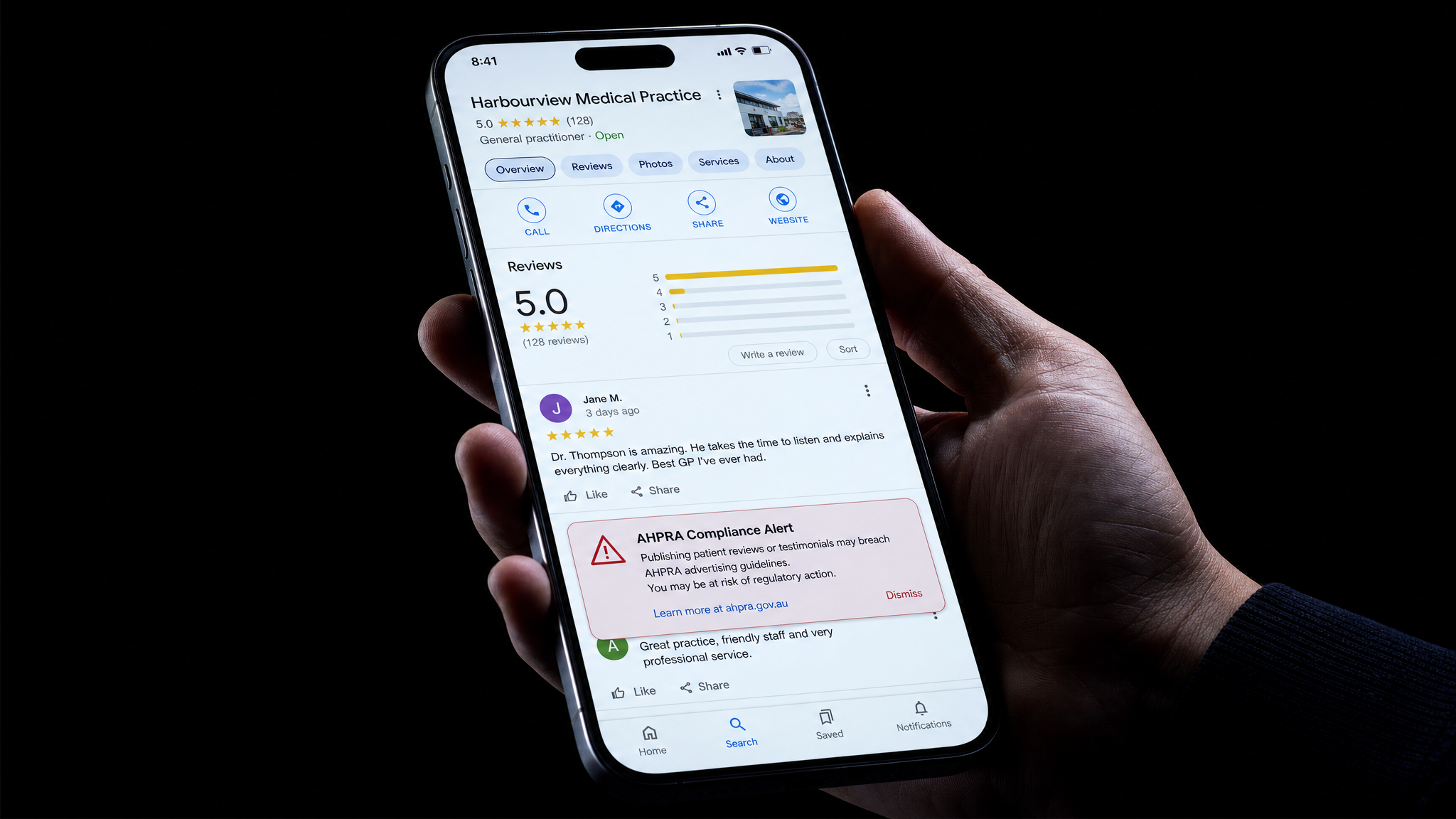
- Displaying Google reviews on your website constitutes using testimonials to advertise regulated health services — a direct breach of Section 133 of the National Law
- AHPRA holds practitioners responsible for ALL advertising content they publish or control, including patient-generated reviews you choose to display
- The prohibition applies to star ratings, text reviews, video testimonials, and aggregated review widgets from any platform (Google, Facebook, Trustpilot, ProductReview)
- Penalties reach $60,000 per offence for individual practitioners and $120,000 for bodies corporate under the 2022 amendments
Why are Google reviews considered testimonials under AHPRA guidelines?
Google reviews constitute testimonials because they represent statements from patients about their experience with your regulated health services. When you embed a Google Reviews widget on your website or feature individual reviews in your marketing materials, you are actively using patient endorsements to advertise your services — exactly what Section 133 of the National Law prohibits.
The critical distinction practitioners often miss is between reviews existing independently on Google's platform versus reviews you actively display or promote. AHPRA's position is clear: while you cannot prevent patients from posting reviews on third-party platforms, you cannot use those reviews as advertising material.
Section 3.4 of the AHPRA Advertising Guidelines defines testimonials broadly as "statements about the quality of services provided by a practitioner or their business." In plain English, this means any patient comment that describes their experience, satisfaction, or outcome falls under the testimonial prohibition — regardless of whether you solicited it or paid for it.
The regulatory logic centres on consumer protection. Testimonials create unrealistic expectations because they showcase selected positive experiences without representing the full spectrum of patient outcomes, individual variations in treatment response, or potential adverse effects. A patient reading "My wrinkles disappeared after treatment!" may form expectations that don't reflect the statistical likelihood of their own results.
Myth: "I didn't write the reviews myself, so I'm not responsible for them."
Reality: AHPRA holds practitioners accountable for advertising content they publish or control. When you embed a Google Reviews widget or feature specific reviews on your website, you are actively choosing to display that content as part of your advertising. The fact that patients wrote the original reviews does not absolve you of responsibility for using them in your marketing.
What counts as "displaying" Google reviews on your website?
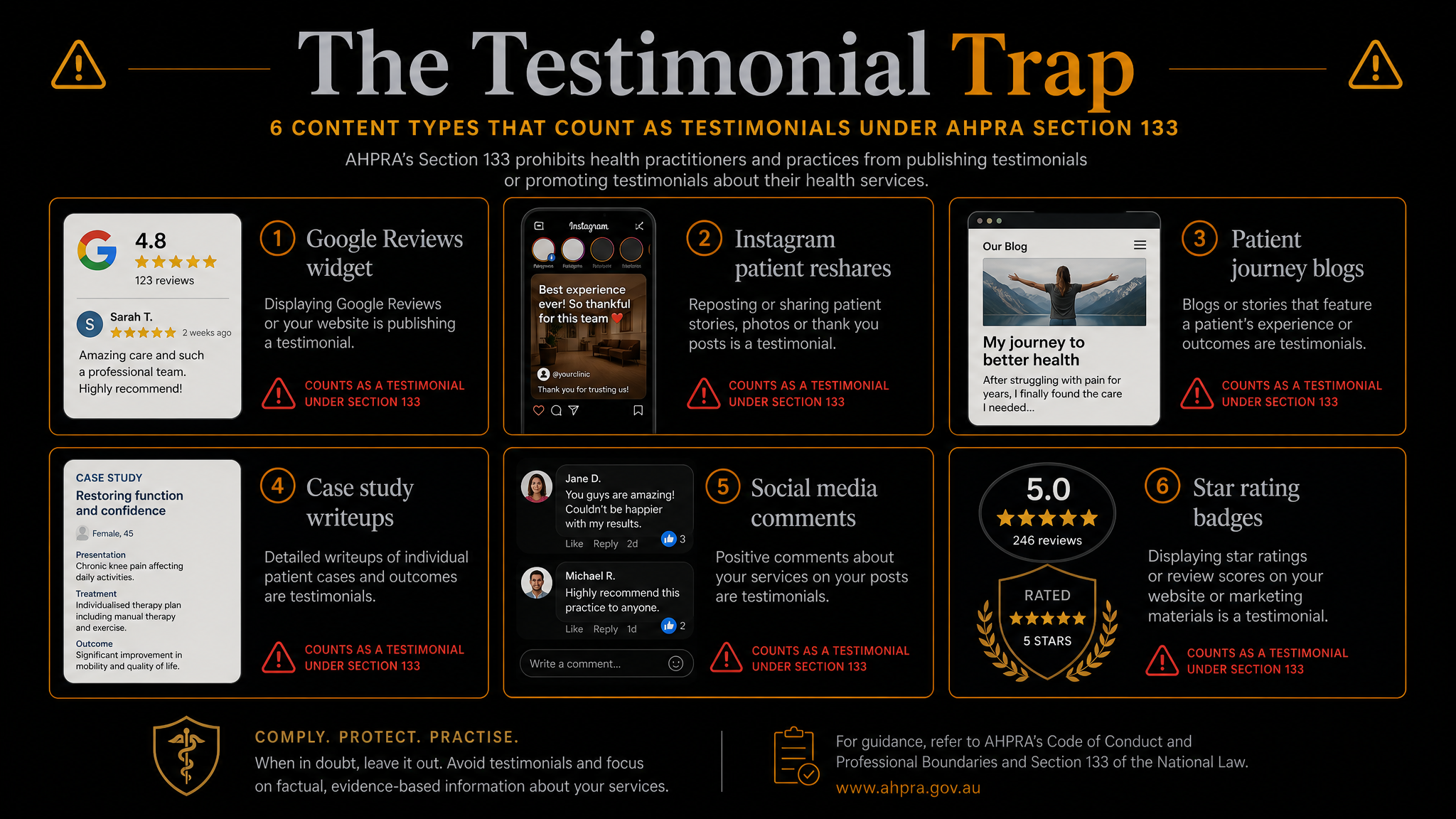
Displaying Google reviews includes embedding review widgets, featuring review screenshots, quoting patient feedback in text, showing star ratings, linking prominently to your Google Business profile from service pages, and any other method that presents patient testimonials as part of your website content. Even automated feeds that pull reviews without manual selection constitute active display of testimonial content.
Practitioners frequently underestimate how broadly AHPRA interprets "using" testimonials. The following all constitute breaches:
- Google Reviews widgets — The embedded modules showing star ratings and scrolling patient comments
- Review aggregator plugins — Tools that compile reviews from multiple platforms (Google, Facebook, Trustpilot) into a single display
- Screenshots of reviews — Capturing individual Google reviews as images and featuring them on service pages or social media
- Text quotes — Extracting patient comments and displaying them as testimonials, even without attribution
- Star rating graphics — Showing "5 stars on Google" badges or similar visual representations
- Video testimonials — Recording patients discussing their experience and hosting these videos on your website or YouTube channel
- "As featured on" sections — Highlighting positive media coverage that includes patient testimonials about your services
The automation defence fails under scrutiny. Some practitioners argue that because a widget automatically pulls reviews without manual curation, they aren't "actively" displaying testimonials. AHPRA rejects this argument — you made the deliberate decision to install the widget, knowing it would display patient feedback. The technical mechanism doesn't change the regulatory reality.
Even indirect methods can breach guidelines. Prominent "Read our Google reviews" calls-to-action on service pages, while not directly displaying the reviews on your site, still use patient testimonials as an advertising tool by directing potential patients to endorsement content as part of your marketing funnel.
What about reviews that exist on Google itself — do I need to remove them?
You cannot be held responsible for reviews that patients post independently on third-party platforms like Google Business, and AHPRA does not require you to remove them. However, you must not respond to reviews in ways that create promotional content, encourage future reviews, or use the reviews as advertising material. Your obligation is to avoid using testimonials, not to police patient speech on independent platforms.
This distinction creates a practical compliance boundary. Reviews existing on Google's platform, which you did not solicit and do not control, fall outside AHPRA's advertising jurisdiction. Google operates as an independent publisher, and patient reviews posted there represent consumer-generated content on a third-party site.
However, three scenarios can convert these independent reviews into compliance risks:
1. Responding to reviews in promotional ways: When you reply to positive Google reviews with responses like "Thank you! We're so glad you love your results — book your next treatment today!", you transform a patient testimonial into advertising material. Your response becomes part of the advertising content visible to potential patients.
2. Soliciting reviews: Actively encouraging patients to leave Google reviews (through follow-up emails, in-clinic signage, or verbal requests) can constitute encouraging testimonials. While the line here is nuanced, systematic review-generation campaigns create regulatory risk.
3. Linking prominently to reviews: While you cannot control reviews on Google, strategically directing potential patients to your Google Business profile specifically to view testimonials effectively uses those reviews as advertising content.
If you choose to respond to Google reviews, keep responses factual and administrative:
- "Thank you for your feedback. We appreciate you taking the time to share your experience."
- "We're glad we could assist you. If you have any questions about your ongoing care, please contact our clinic directly."
Avoid any language that promotes your services, describes treatment outcomes, or encourages others to book appointments.
For negative reviews, you face additional constraints under patient privacy obligations. Never disclose that someone was a patient or discuss any clinical details in a public response. A compliant response to a negative review: "Thank you for your feedback. We take all concerns seriously. Please contact our practice manager directly so we can address this privately."
What penalties apply if AHPRA finds testimonials on your website?
AHPRA can impose penalties up to $60,000 per offence for individual practitioners and $120,000 per offence for bodies corporate under the Health Practitioner Regulation National Law amendments that took effect in 2022. Each displayed review can constitute a separate offence, and AHPRA may also impose conditions on your registration, require mandatory education, or refer serious cases for disciplinary action.
Under the Health Practitioner Regulation National Law (as amended 2022):
- Individual practitioners: up to $60,000 per offence
- Bodies corporate: up to $120,000 per offence
Source: Health Practitioner Regulation National Law and Other Legislation Amendment Act 2022
The "per offence" language creates multiplicative risk. If your homepage displays a Google Reviews widget showing ten patient testimonials, AHPRA may treat this as ten separate breaches. A website featuring review widgets on multiple service pages compounds the exposure.
Beyond financial penalties, AHPRA's enforcement powers include:
- Registration conditions — Restrictions placed on your practice, such as mandatory supervision or prohibition from advertising specific services
- Mandatory education — Requirements to complete advertising compliance training at your expense
- Public cautions — Formal warnings published on AHPRA's public register, visible to patients searching your name
- Suspension or cancellation — In serious or repeated breach cases, AHPRA can suspend or cancel your registration
The reputational damage often exceeds the financial penalty. A published caution on AHPRA's register signals to patients that you've breached advertising standards, potentially undermining the trust you've built in your practice.
AHPRA's compliance and enforcement strategy prioritises cosmetic procedure advertising, particularly for prescription injectable treatments. The regulator actively monitors cosmetic injector websites and social media, making this a high-scrutiny area. Displaying testimonials in this specialty attracts disproportionate enforcement attention compared to other health advertising breaches.
For context on how AHPRA approaches testimonial violations across platforms, see our detailed guide on how "free consultation" offers can breach inducement guidelines and our analysis of before-and-after photo compliance requirements.
How should cosmetic injectors handle existing Google reviews on their websites?
Remove all Google Reviews widgets, embedded review displays, review screenshots, and testimonial quotes from your website immediately. Audit every page including homepage, service pages, about pages, and blog posts. Replace testimonial content with evidence-based information about treatment options, practitioner qualifications, and educational resources that help patients make informed decisions without relying on other patients' experiences.
Compliance requires a systematic audit across your entire digital presence:
- Homepage: Remove review widgets, star rating graphics, and "What our patients say" sections
- Service pages: Delete patient quotes, before-and-after testimonial combinations, and review excerpts
- About/Team pages: Remove any patient feedback about specific practitioners
- Blog posts: Audit articles that may quote patient experiences or feature case studies written as testimonials
- Footer and sidebar widgets: Check for automated review feeds in template areas
- Landing pages: Review any campaign-specific pages created for advertising
- Third-party integrations: Disable plugins or tools that pull review content from external platforms
After removal, redirect your content strategy toward compliant trust-building methods:
Practitioner credentials: Feature your AHPRA registration number, qualifications, years of experience, and specialised training prominently. Patients can verify your registration status directly with AHPRA, providing objective trust signals without testimonials.
Educational content: Publish detailed information about treatment mechanisms, expected timelines, potential side effects, and contraindications. Evidence-based education helps patients form realistic expectations without relying on anecdotal experiences.
Treatment process transparency: Describe your consultation approach, assessment methods, and follow-up protocols. Process transparency builds confidence through professionalism rather than patient endorsements.
Published research: Where applicable, reference peer-reviewed studies about treatment efficacy, safety profiles, and clinical outcomes. Scientific evidence provides credible support for your services without violating testimonial prohibitions.
Many practitioners worry that removing reviews will damage their competitive position. The reality is that compliant competitors operate under the same constraints. Differentiation must come from clinical expertise, patient education, and service quality — not from showcasing testimonials that create regulatory risk.
For comprehensive guidance on advertising cosmetic injectable treatments compliantly, review the cosmetic injectors compliance requirements and understand how AHPRA's testimonial laws apply across all platforms.
What about displaying star ratings without the actual review text?
Displaying star ratings alone — even without accompanying review text — still constitutes using testimonials to advertise regulated health services. Star ratings represent aggregated patient endorsements and create the same unrealistic expectations that testimonial prohibitions are designed to prevent. AHPRA's guidelines make no exception for ratings-only displays versus full text reviews.
Some practitioners attempt to parse the testimonial prohibition by displaying only the numerical or star rating component from Google, reasoning that without specific patient statements, they're not technically showing "testimonials." This interpretation fails on both regulatory and logical grounds.
A five-star rating communicates patient satisfaction as clearly as a written review stating "Excellent service!" The star rating is simply a standardised format for expressing the same endorsement. AHPRA's concern about unrealistic expectations applies equally — a patient seeing "4.9 stars from 127 reviews" forms expectations about treatment quality and outcomes based on other patients' experiences.
The updated AHPRA Advertising Guidelines explicitly address this, stating that testimonials include "ratings, reviews, or other forms of endorsement." In plain English, any patient-generated content that signals approval or satisfaction falls under the prohibition, regardless of format.
All of these constitute testimonial use:
- "Rated 5 stars on Google" badges or graphics
- Displaying average star ratings with review counts
- Showing aggregated ratings from multiple platforms
- "Award" graphics based on review scores (e.g., "Top Rated 2026")
- Comparative rating displays (e.g., "Higher rated than 95% of local providers")
The format neutrality of the testimonial prohibition means you cannot circumvent it through creative presentation. Whether you display full reviews, excerpts, star ratings, numerical scores, or graphical representations, you're using patient endorsements as advertising material.
How can cosmetic injectors build patient trust without using testimonials?
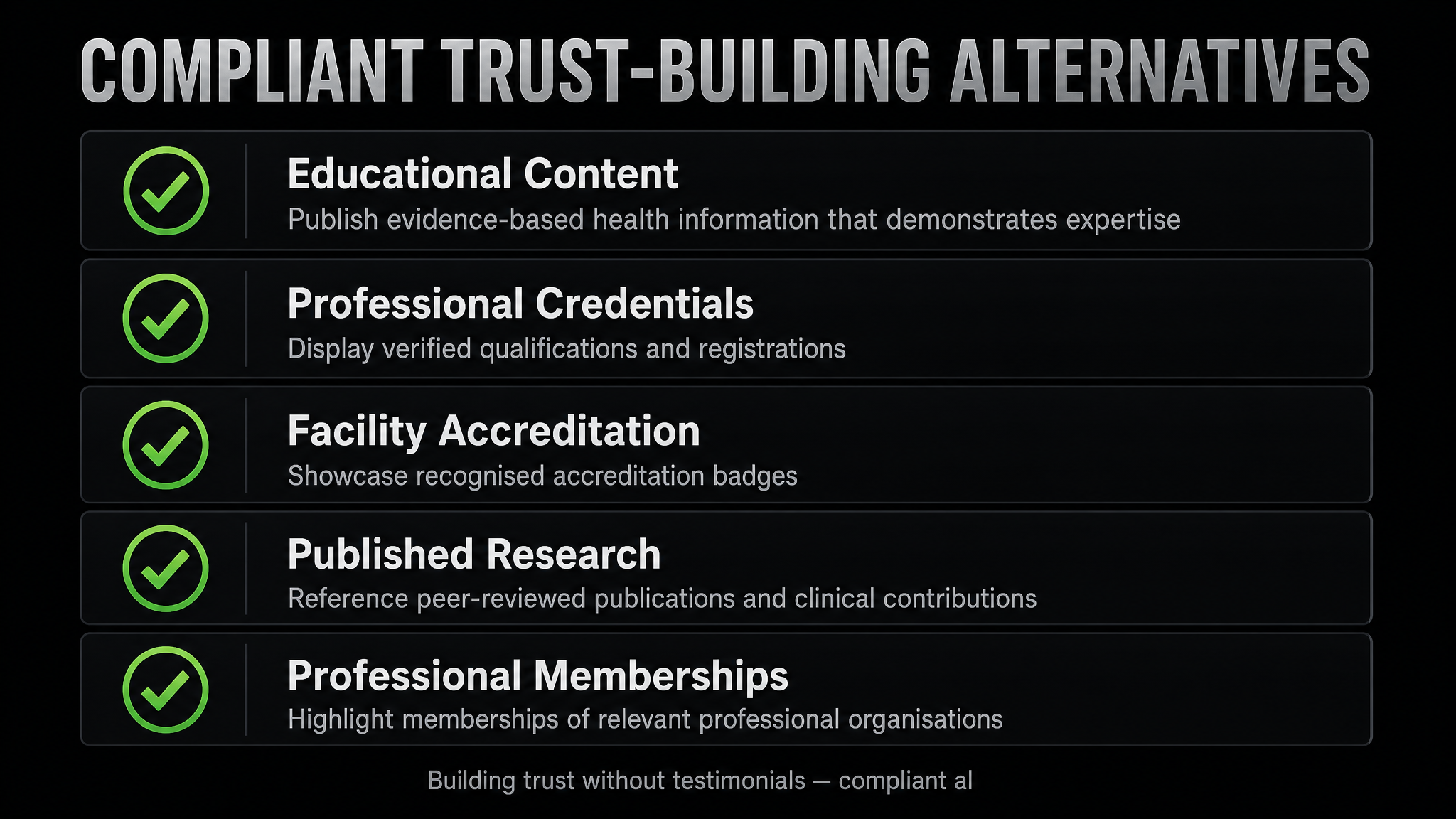
Build trust through verifiable credentials, transparent communication about risks and limitations, evidence-based treatment information, professional affiliations, ongoing education, and detailed consultation processes that demonstrate clinical expertise. These approaches provide objective trust signals that help patients make informed decisions without relying on subjective patient experiences that create unrealistic expectations.
The testimonial prohibition forces practitioners toward more substantive trust-building methods that ultimately serve patients better. Consider these compliant alternatives:
Comprehensive practitioner profiles: Detail your training pathway, years of experience with specific treatments, professional memberships, and continuing education. Include your AHPRA registration number prominently so patients can verify your credentials independently. Specific qualifications (e.g., "Advanced Diploma of Cosmetic Dermal Science, 8 years clinical experience with dermal fillers") provide concrete trust signals.
Treatment education libraries: Publish detailed guides explaining how treatments work, what patients can realistically expect, recovery timelines, potential complications, and contraindications. Educational content demonstrates expertise while helping patients form appropriate expectations. A thorough guide to dermal filler procedures that honestly discusses swelling, bruising, and rare complications builds more sustainable trust than glowing testimonials that omit these realities.
Transparent pricing and process information: Clearly explain your consultation approach, assessment methods, treatment protocols, and follow-up care. Transparency about what patients can expect from their journey with your practice reduces anxiety and builds confidence. Include information about cooling-off periods, consent processes, and complaint mechanisms as required for cosmetic procedures.
Clinical photography protocols: If you use before-and-after images, ensure they comply with all requirements: genuine patients, unedited images, identical conditions, appropriate disclaimers about individual variation, and written consent. Compliant clinical photography demonstrates your outcomes without testimonial content. Review our comprehensive guide on before-and-after photo disclaimer requirements for specific compliance standards.
Published case studies (non-testimonial format): You can present clinical cases in an educational format that focuses on treatment selection, technique, and outcomes without featuring patient endorsements. The distinction: educational case studies describe clinical decision-making and results objectively, while testimonials feature patient satisfaction and subjective experiences. A compliant case study discusses "Patient presented with moderate nasolabial folds, treated with 1ml dermal filler, showing typical improvement at 2-week follow-up" rather than "Patient loved her results and said she felt 10 years younger!"
Professional affiliations and accreditations: Membership in relevant professional bodies (Australian Society of Plastic Surgeons, Cosmetic Physicians College of Australasia, Australasian College of Aesthetic Medicine) provides third-party validation of your professional standing.
Instead of a testimonials section, feature:
"Why Choose Our Clinic"
- AHPRA-registered practitioners with 10+ years cosmetic injectables experience
- Advanced training in complication management and facial anatomy
- Comprehensive consultation process including medical history review, risk assessment, and realistic outcome discussion
- Mandatory 7-day cooling-off period for all new patients
- Transparent pricing with no hidden fees
- 24/7 post-treatment support line for concerns
This provides concrete, verifiable information that helps patients assess your practice without relying on testimonials.
These compliant methods require more effort than embedding a review widget, but they build deeper trust based on professional competence rather than patient endorsements. They also align with the broader regulatory goal of helping patients make decisions based on clinical appropriateness rather than social proof.
For a comprehensive approach to compliant cosmetic procedure advertising, use an AHPRA advertising compliance checker to audit your website content before publication.
What if my competitors are displaying Google reviews — should I report them?
Competitors displaying testimonials are operating in breach of AHPRA guidelines and face the same penalty risks you avoid by maintaining compliance. You can report suspected breaches through AHPRA's notification system, but your primary obligation is ensuring your own compliance. Widespread non-compliance among competitors does not reduce your regulatory risk or create a defence if AHPRA investigates your advertising.
Many practitioners express frustration that competitors gain marketing advantages through non-compliant testimonial use while compliant practices forgo this promotional tool. This frustration is understandable but creates dangerous reasoning: "If everyone else is doing it, I should too."
AHPRA's enforcement approach is complaint-driven and risk-prioritised. The regulator cannot simultaneously investigate every non-compliant website, so enforcement appears inconsistent. However, this does not mean non-compliant practices are safe — it means they haven't been caught yet. Cosmetic procedure advertising remains a high-priority enforcement area, and AHPRA's compliance activities continue to expand.
If you identify competitors displaying testimonials, you have several options:
Submit an AHPRA notification: You can report suspected advertising breaches through AHPRA's notifications process. Provide specific details including URLs, screenshots, and explanation of the suspected breach. AHPRA assesses all notifications and may investigate.
Focus on your own compliance: Alternatively, maintain your compliant position and differentiate through the trust-building methods discussed above. Over time, as enforcement increases, compliant practices gain competitive advantage by avoiding penalties, registration conditions, and reputational damage.
Educate your market: Some practitioners address this through patient education, explaining why they don't display testimonials and framing compliance as a commitment to evidence-based practice and regulatory professionalism.
The "everyone else is doing it" defence has never succeeded in an AHPRA enforcement action. When AHPRA investigates your advertising, your compliance is assessed against the regulatory standards, not against competitor behaviour. The fact that ten other clinics in your area display testimonials provides zero protection if AHPRA issues you a penalty notice.
Consider the risk calculus: maintaining compliance costs you the marketing benefit of testimonials but eliminates penalty risk, registration conditions, and reputational damage. Breaking compliance to match competitors gives you short-term marketing benefit but exposes you to penalties up to $60,000 per offence, potential registration conditions, and public cautions that damage your professional reputation permanently.
- AHPRA Advertising Guidelines — Section 3.4 Testimonials and Endorsements, updated guidance on acceptable evidence in health advertising
- Health Practitioner Regulation National Law — Section 133 advertising offences, penalty provisions as amended 2022
- AHPRA Cosmetic Procedure Advertising Guidelines — Enhanced requirements for cosmetic procedure advertising including testimonial prohibitions
- AHPRA Notifications Process — How to report suspected advertising breaches
Regulations verified current as of 02 June 2026.
This article is for educational purposes only and does not constitute legal or medical advice. Practitioners should consult their legal adviser or AHPRA directly for guidance specific to their circumstances.
Dr Hercules Kollias
AHPRA-registered practitioner · 30 years clinical experience
Founder, The Compliance Scalpel
Dr Kollias built The Compliance Scalpel after three decades of clinical practice — encoding hard-won knowledge of AHPRA and TGA advertising rules into automated compliance tooling for Australian healthcare practitioners.
Is Your Website Compliant Right Now?
The Compliance Sentinel continuously monitors your practice website for AHPRA and TGA advertising risks — so you know the moment something needs attention.
Learn About Sentinel