Your 'Award-Winning' Claims Require Documentary Evidence
Reviewed by Dr Hercules Kollias, AHPRA-registered practitioner · 30 years clinical experience
Who this applies to: All AHPRA-registered practitioners advertising health services, particularly cosmetic injectors, cosmetic surgeons, dental practitioners, physiotherapists, and any practice displaying awards, accolades, or recognition claims in advertising materials.
- Every award claim in your advertising must be supported by documentary evidence from a legitimate third-party source that you can produce on demand during AHPRA investigations.
- Self-created awards, patient-voted online polls without verification, and unsubstantiated 'best' claims are treated as false advertising under Section 133 of the National Law.
- AHPRA does not require pre-approval of award claims, but you bear the burden of proof—if you cannot substantiate the claim when challenged, you face penalties up to $60,000 for individuals and $120,000 for bodies corporate.
- The September 2025 cosmetic procedure updates impose stricter scrutiny on superiority claims including awards for higher-risk procedures like injectable treatments and cosmetic surgery.
What evidence does AHPRA require for award claims?
AHPRA requires documentary evidence that proves the award exists, was legitimately conferred by a credible third party, was actually received by your practice or practitioner, and accurately reflects the scope claimed in your advertising. This means certificates, official correspondence, judging criteria, and verification of the awarding organisation's legitimacy.
Section 3.7 of the AHPRA Advertising Guidelines prohibits advertising that is false, misleading, or deceptive. In plain English, this means any factual claim you make—including awards, recognition, or accolades—must be objectively true and verifiable.
The documentary evidence standard includes:
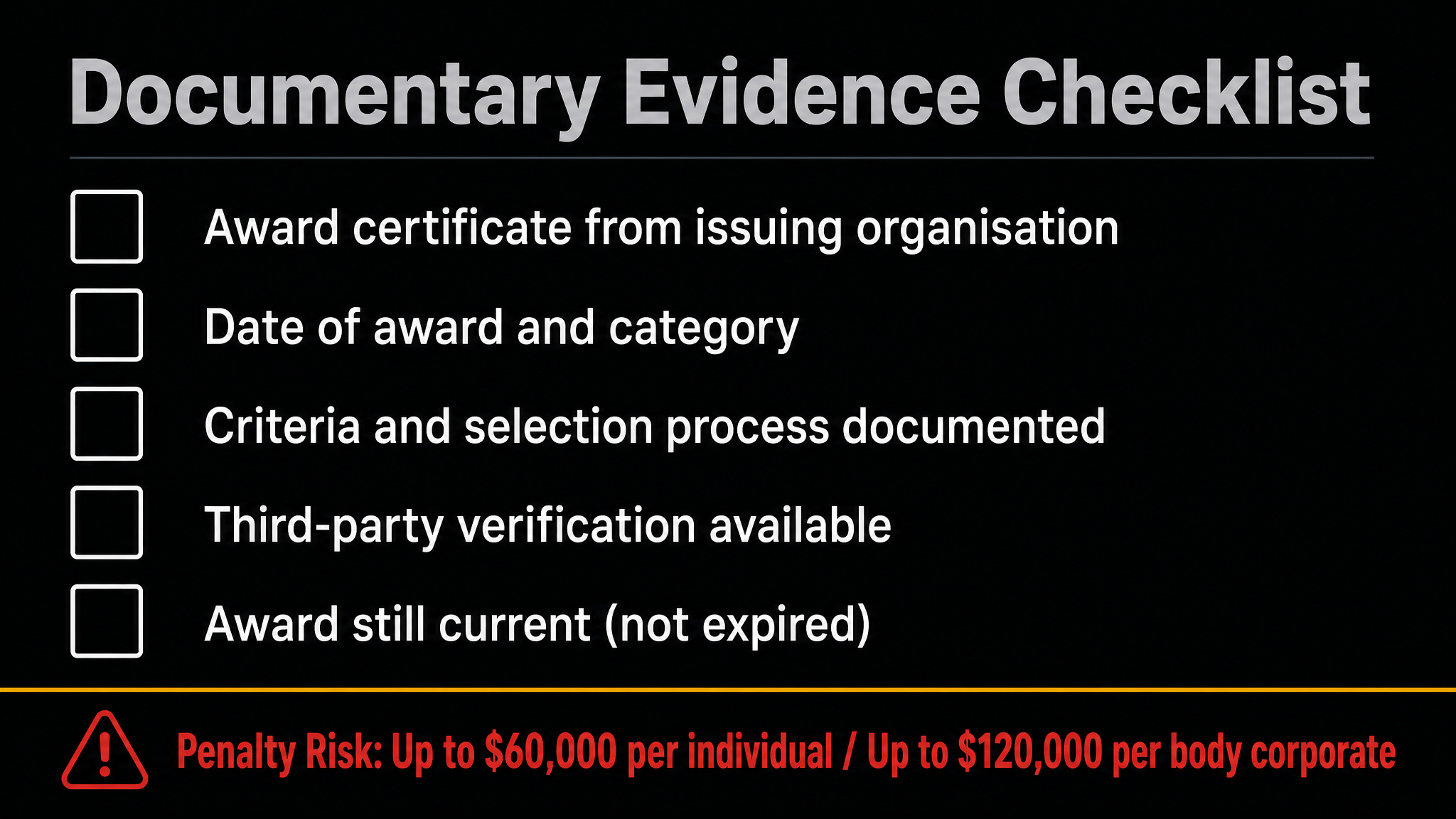
- Award certificate or official notification showing the recipient name, award title, year, and issuing organisation
- Verification of the awarding body demonstrating it is a legitimate, independent third party with credible judging processes
- Judging criteria and methodology if the award involved competitive assessment
- Scope limitations clearly documented—if you won "Best Injectable Clinic in Eastern Suburbs 2023", you cannot advertise "Award-Winning Clinic" without the geographic and temporal qualifiers
- Current validity if the award has an expiration date or annual renewal requirement
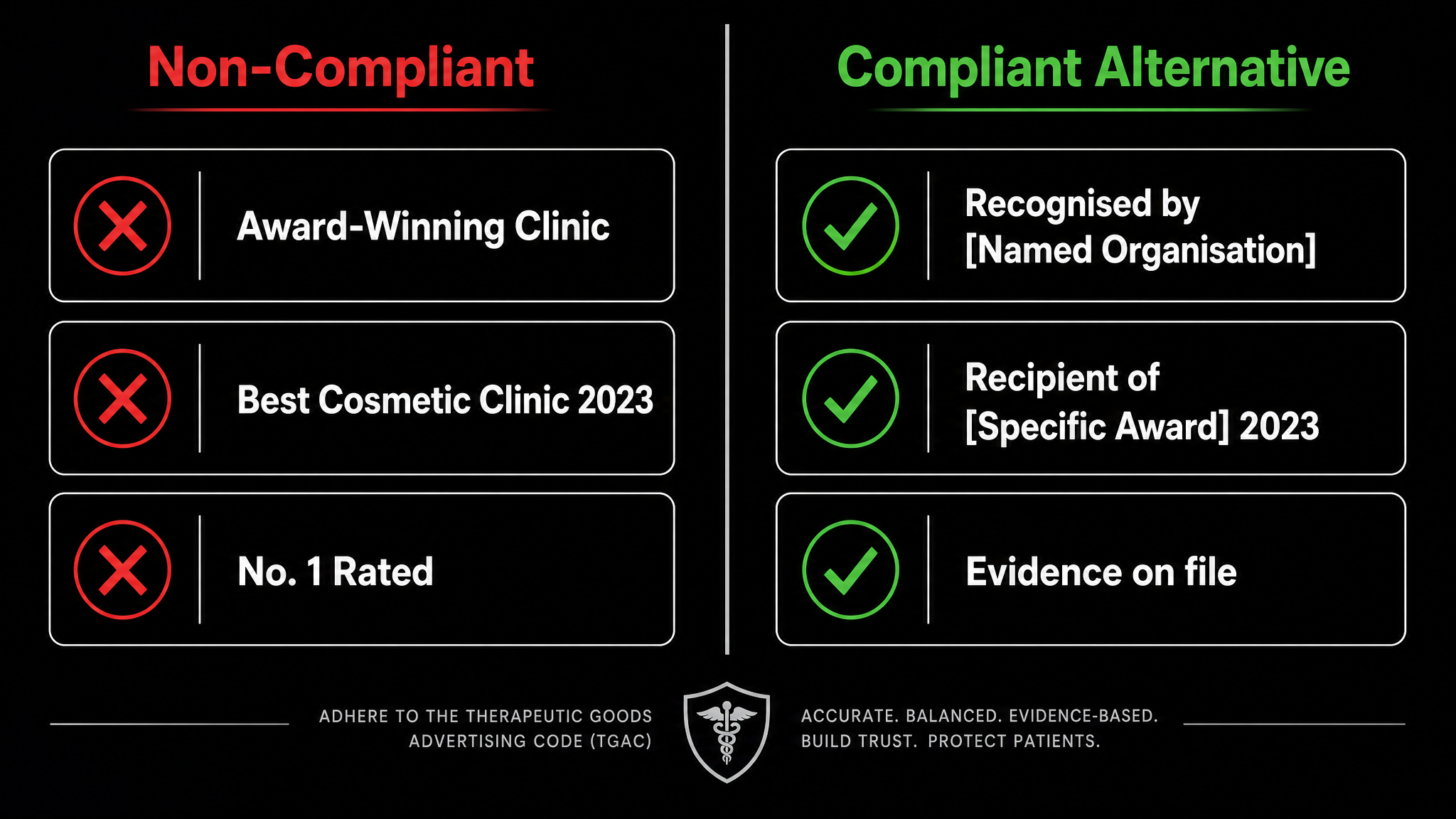
AHPRA investigators do not assess the prestige or merit of the award itself. Their focus is binary: can you prove the claim you are making is factually accurate? If you display "Award-Winning Cosmetic Clinic" on your homepage, you must produce evidence of an award specifically for cosmetic services, conferred to your clinic, that uses language reasonably described as an "award".
Myth: If an award appears on a legitimate-looking website or certificate, it's acceptable to use in advertising.
Reality: Many "awards" are pay-to-play schemes where clinics purchase plaques or digital badges without any competitive assessment. AHPRA requires evidence of a legitimate selection process. Simply paying for an award listing does not make the claim compliant under Section 3.7 of the Guidelines.
Which types of awards trigger the highest compliance risk?
Self-created awards, patient-voted online polls without independent verification, purchased awards from commercial directories, and vague superiority claims like "best" or "top-rated" without objective evidence create the highest risk of AHPRA action for false or misleading advertising.
High-risk award categories include:
Self-conferred recognition: Creating your own award titles such as "Centre of Excellence" or "Premium Provider" without third-party assessment is inherently misleading. These suggest external validation that does not exist. Even if you disclose the self-created nature in fine print, the dominant impression—the overall message a reasonable consumer receives—may still mislead under Australian Consumer Law Section 18.
Pay-to-play directories: Many online business directories offer "award" badges or "featured provider" status in exchange for advertising fees. Unless there is a genuine competitive selection process independent of payment, these do not constitute legitimate awards. AHPRA has specifically cautioned against using paid directory placements as evidence of superiority or recognition.
Unverified patient voting: Online polls asking "Vote for Your Favourite Clinic" without identity verification, voting controls, or independent auditing can be easily manipulated. If you cannot demonstrate the voting process was legitimate and the results verifiable, the award claim fails the substantiation test. Additionally, patient-voted awards may overlap with testimonial prohibitions under Section 133 if they function as aggregated patient endorsements.
Expired or outdated awards: Displaying "Best Cosmetic Clinic 2021" in 2026 without clarifying the historical nature creates a misleading impression of current recognition. If you continue to use award claims beyond their validity period, you must clearly date-stamp them and ensure the overall impression does not suggest current status.
Scope-inflated claims: Winning "Best Customer Service" but advertising "Award-Winning Cosmetic Treatments" misrepresents the scope of recognition. The claim must accurately reflect what was actually assessed and awarded.
A cosmetic clinic receives the "Excellence in Patient Safety 2025" award from the Australasian College of Cosmetic Surgery after a rigorous audit of clinical protocols. The clinic displays: "Recipient of the ACCS Excellence in Patient Safety Award 2025" with a footnote linking to the awarding body's verification page. This is substantiated, specific, and verifiable.
How does AHPRA investigate award claims?
AHPRA investigations are typically triggered by competitor complaints, consumer reports, or proactive monitoring. Investigators issue a formal notice requiring you to substantiate the award claim within a specified timeframe—usually 28 days. Failure to produce satisfactory evidence results in breach findings and penalties.
The investigation process follows this pattern:
Complaint receipt: A competitor practitioner, consumer, or AHPRA's own surveillance identifies an award claim that appears unsubstantiated. Competitor complaints are common in cosmetic medicine where practices operate in close proximity and monitor each other's marketing. You can read more about the AHPRA complaints process on the official portal.
Preliminary assessment: AHPRA reviews the advertising material and determines whether the claim falls within regulated health advertising. Award claims on websites, social media profiles, Google Business listings, printed brochures, and clinic signage all constitute advertising under the National Law.
Notice to produce evidence: AHPRA issues a formal request requiring documentary evidence supporting the award claim. This notice specifies exactly what must be provided: proof the award exists, proof your practice received it, proof the awarding body is legitimate, and proof the claim accurately represents the award scope.
Evidence assessment: AHPRA evaluates whether the evidence satisfies the substantiation standard. They assess the credibility of the awarding organisation, the transparency of selection criteria, and whether the claim in your advertising accurately reflects the actual award received. If you won "Top 10 Cosmetic Clinics in Sydney" but advertise "Award-Winning Australia-Wide", the geographic scope inflation constitutes misrepresentation.
Breach determination: If evidence is absent, insufficient, or reveals the claim is false or misleading, AHPRA determines a breach of Section 133 has occurred. This triggers penalty proceedings under the National Law.
Importantly, AHPRA does not accept "good faith" or "honest mistake" as defences. Under Section 133, advertising breaches are strict liability offences. Your intention is irrelevant—if the claim cannot be substantiated, the breach is established. This is similar to the compliance risks discussed in specialist title claims, where practitioners cannot use protected titles even if they genuinely believe they qualify.
What penalties apply to unsubstantiated award claims?
Unsubstantiated award claims are prosecuted as false or misleading advertising under Section 133 of the National Law, carrying penalties up to $60,000 for individual practitioners and $120,000 for bodies corporate per offence. Each advertising platform displaying the false claim can constitute a separate offence.
Under the Health Practitioner Regulation National Law (as amended 2022):
- Individual practitioners: up to $60,000 per offence
- Bodies corporate: up to $120,000 per offence
Source: Health Practitioner Regulation National Law and Other Legislation Amendment Act 2022
The penalty structure creates significant financial exposure because AHPRA can treat each instance of the false claim as a separate offence. If "Award-Winning Injectable Treatments" appears on your website homepage, Instagram bio, Facebook page, Google Business listing, and printed brochure, that could constitute five separate offences—potentially $300,000 for an individual practitioner or $600,000 for a corporate entity.
Beyond financial penalties, consequences include:
Mandatory corrective advertising: AHPRA may require you to publish corrections across all platforms where the false claim appeared, at your expense. This public retraction damages reputation and consumer trust far beyond the immediate penalty.
Conditions on registration: Serious or repeated advertising breaches can result in conditions imposed on your AHPRA registration, including mandatory compliance training, supervision requirements, or prohibition on certain advertising activities.
Reputational damage: AHPRA publishes outcomes of disciplinary proceedings on public registers. Prospective patients searching your name will find breach findings, creating long-term commercial harm.
Australian Consumer Law liability: False award claims can also breach Section 18 of the Australian Consumer Law, which prohibits misleading or deceptive conduct. The Australian Competition and Consumer Commission (ACCC) can pursue separate penalties up to $2,500,000 for individuals and $50,000,000 for corporations. While ACCC prosecution of individual healthcare providers is rare, the legal exposure exists for egregious cases.
For cosmetic practitioners specifically, the September 2025 updates to AHPRA's cosmetic procedure guidelines impose heightened scrutiny on all superiority claims including awards. Regulators are actively monitoring cosmetic advertising following public concern about aggressive marketing practices. This mirrors the enforcement approach to testimonial violations, where cosmetic injectors face disproportionate regulatory attention.
How should practices audit existing award claims?
Conduct a comprehensive audit of all advertising platforms identifying every award, recognition, or superiority claim, then assemble documentary evidence for each claim or immediately remove unsubstantiated statements. This audit should cover digital and physical advertising including website content, social media profiles, email signatures, and clinic signage.
- Inventory all claims: Search your website, Google Business listing, Facebook, Instagram, LinkedIn, printed materials, signage, and email signatures for terms like "award", "best", "top", "leading", "premier", "excellence", "recognised", or "accredited".
- Assemble evidence files: For each claim, compile the award certificate, official notification, awarding body details, judging criteria, and verification of legitimacy into a dedicated compliance file.
- Verify current validity: Confirm awards have not expired and any ongoing requirements (annual fees, re-assessment) have been met.
- Check scope accuracy: Ensure your advertising claim precisely matches the award scope—if you won "Best Clinic in Northern Suburbs", you cannot advertise "Award-Winning Across Melbourne".
- Assess awarding body credibility: Research the organisation that conferred the award—is it an independent professional body, industry association, or credible media outlet? Or is it a commercial directory selling award placements?
- Remove unsubstantiated claims immediately: Any claim you cannot substantiate with documentary evidence must be deleted from all advertising platforms within 24-48 hours of identification.
- Document the audit process: Maintain records showing when you conducted the audit, what was found, and what corrective action was taken. This demonstrates good faith compliance efforts if AHPRA later investigates.
For cosmetic practices advertising higher-risk procedures, this audit is particularly urgent. The September 2025 guidelines require all cosmetic procedure advertising to be "transparent, factual, and educational" rather than persuasive. Award claims that create aspirational associations or glamorise procedures may breach these enhanced standards even if technically substantiated. Consider whether award claims serve an educational purpose or simply function as promotional puffery.
Practices using AHPRA advertising compliance checkers can automate detection of award claims requiring substantiation, flagging terms like "award-winning", "best", and "top-rated" for manual evidence review before publication.
What constitutes a legitimate award for compliance purposes?
A legitimate award for AHPRA compliance purposes is conferred by an independent third party, involves objective assessment criteria, is verifiable through the awarding organisation, and was actually received by your practice for the specific scope you claim in advertising.
Legitimate award characteristics include:
Independent third-party conferral: The awarding body must be separate from your practice with no financial relationship beyond standard entry fees. Professional colleges, industry associations, credible media outlets conducting transparent judging, and government bodies meet this standard. Organisations where you purchased membership specifically to receive an award do not.
Transparent selection criteria: The award methodology must be documented and publicly available. Judging panels, assessment rubrics, eligibility requirements, and selection processes should be disclosed by the awarding organisation. Secret or undisclosed criteria suggest the award lacks credibility.
Competitive or merit-based assessment: Legitimate awards involve evaluation against objective standards or comparison with other candidates. Automatic awards for meeting minimum thresholds (like maintaining professional registration or paying membership fees) do not constitute meaningful recognition for advertising purposes.
Verifiable through the awarding body: The organisation that conferred the award should maintain public records or provide verification upon request. If a consumer or AHPRA investigator contacts the awarding body, they should be able to confirm your practice received the stated award in the stated year.
Accurately represented scope: Your advertising claim must match the actual award scope without inflation or generalisation. If you won "Excellence in Laser Skin Treatments", you cannot advertise "Award-Winning Cosmetic Surgery Practice".
Be cautious of awards that:
- Require substantial payment beyond reasonable entry fees
- Are offered to every practice that applies or pays
- Come from organisations with no transparent governance or judging process
- Cannot be verified through the awarding body's official channels
- Use vague language like "nominated for" or "featured in" rather than "recipient of"
- Arrive unsolicited with invoices for plaques or promotional materials
Professional recognition from bodies like the Australasian College of Cosmetic Surgery, Australian Society of Plastic Surgeons, or state-based medical associations generally meets legitimacy standards, provided the recognition involved genuine assessment and your advertising accurately represents its scope. Similarly, media awards from established publications with disclosed judging processes (such as major metropolitan newspapers' annual "best of" awards with transparent voting) can be substantiated if you retain evidence of the selection process.
The key question practitioners should ask: "If AHPRA contacted the awarding organisation tomorrow, would they confirm we received this award for the specific reason and scope we're claiming?" If the answer is uncertain, the claim should not appear in your advertising.
How do cosmetic procedure updates affect award claims?
The September 2025 AHPRA updates for higher-risk cosmetic procedures impose stricter standards on all superiority claims including awards, requiring that advertising be factual and educational rather than persuasive, and prohibiting content that glamorises or trivialises cosmetic procedures.
These enhanced standards mean award claims for cosmetic practices face additional scrutiny beyond basic substantiation requirements:
Educational purpose test: Award claims must serve a genuinely informative purpose rather than functioning primarily as persuasive marketing. An award for "Excellence in Patient Safety Protocols" arguably educates consumers about clinical standards. An award for "Most Luxurious Clinic Experience" glamorises cosmetic procedures without educational value and may breach the updated guidelines.
Idealisation prohibition: The September 2025 updates specifically prohibit advertising that idealises cosmetic procedures or creates unrealistic expectations. Award claims that suggest your practice delivers superior aesthetic outcomes or positions cosmetic treatments as aspirational lifestyle choices may breach these standards even if the award itself is legitimate.
Risk disclosure context: For higher-risk procedures like cosmetic surgery and prescription injectable treatments, advertising must include clear information about risks, costs, practitioner qualifications, and recovery. Award claims that dominate your advertising without proportionate risk disclosure create an unbalanced impression that may mislead consumers about the nature of these medical procedures.
Cosmetic injectors face particular complexity because the September 2025 updates prohibit naming prescription injectable products by brand, generic name, or slang terms. If your award specifically references a product name (such as "Best [Brand Name] Injector 2025"), you cannot advertise this award because it would breach the product naming prohibition. You would need to obtain written confirmation from the awarding body that they will refer to your award using compliant terminology like "Best Injectable Treatment Provider".
These cosmetic-specific requirements layer on top of the general substantiation standards, creating a higher compliance bar for cosmetic practices than other healthcare specialties. This reflects AHPRA's policy position that cosmetic procedure advertising requires enhanced consumer protection due to the elective nature of treatments and heightened risk of harm from inappropriate marketing. The approach parallels restrictions on cosmetic injector advertising across multiple compliance dimensions.
What alternatives exist to award claims in healthcare advertising?
Instead of award claims, practices can differentiate through factual statements about practitioner qualifications, professional memberships, years of experience, specialised training, published research, teaching appointments, and specific clinical capabilities—all of which are substantiable and lower-risk than subjective superiority claims.
Compliant differentiation strategies include:
Specific qualifications and credentials: Rather than "Award-Winning Cosmetic Surgeon", state "Fellowship-trained Cosmetic Surgeon with Australian Society of Plastic Surgeons membership and 15 years specialist experience". This provides objective information consumers can verify and positions expertise without subjective superiority claims.
Professional teaching and research roles: If your practitioners hold university teaching appointments, have published peer-reviewed research, or present at professional conferences, these are factual achievements that demonstrate expertise without requiring award substantiation. "Dr Smith lectures in cosmetic medicine at [University Name] and has published 12 peer-reviewed articles on laser treatments" is both impressive and objectively verifiable.
Specific procedural experience: Quantifiable experience metrics like "Over 5,000 injectable treatments performed" or "Specialist training in [specific technique] at [recognised institution]" provide meaningful information without subjective quality claims. Ensure any numerical claims can be substantiated with treatment records if challenged.
Professional body memberships: Membership in recognised professional organisations like the Australasian College of Cosmetic Surgery, Australian Society of Plastic Surgeons, or specialty-specific associations demonstrates commitment to professional standards. These memberships are easily verifiable and carry more credibility than many commercial awards.
Facility accreditation: If your practice holds accreditation from recognised bodies like the Australian Council on Healthcare Standards (ACHS) or operates in accredited day hospital facilities, this demonstrates adherence to safety and quality standards without subjective superiority claims.
Instead of: "Award-Winning Cosmetic Injectable Clinic"
Use: "Dr Jane Chen, MBBS, FACCS, with 12 years specialist experience in cosmetic medicine. Fellow of the Australasian College of Cosmetic Surgery. Over 8,000 injectable treatments performed. Procedures conducted in ACHS-accredited facility."
This provides substantive, verifiable information that differentiates the practice without unsubstantiated superiority claims.
These factual alternatives often prove more persuasive to informed consumers than generic award claims, while simultaneously reducing regulatory risk. Patients researching cosmetic procedures increasingly seek specific qualifications and experience metrics rather than subjective marketing claims. By focusing advertising on verifiable credentials rather than awards, practices align commercial objectives with compliance requirements.
- AHPRA Advertising Guidelines (March 2020, updated September 2025) — Section 3.7 (False, misleading or deceptive claims) and Section 3.1 (Substantiation of claims)
- Health Practitioner Regulation National Law Act 2009 — Section 133 (Advertising offences and penalties, as amended 2022)
- AHPRA Complaints and Notifications Process — Procedures for investigating advertising breaches
Regulations verified current as of 08 June 2026.
This article is for educational purposes only and does not constitute legal or medical advice. Practitioners should consult their legal adviser or AHPRA directly for guidance specific to their circumstances.
Dr Hercules Kollias
AHPRA-registered practitioner · 30 years clinical experience
Founder, The Compliance Scalpel
Dr Kollias built The Compliance Scalpel after three decades of clinical practice — encoding hard-won knowledge of AHPRA and TGA advertising rules into automated compliance tooling for Australian healthcare practitioners.
Check Before You Publish
The Compliance Scalpel audits your healthcare marketing content against AHPRA and TGA guidelines before it goes live. Catch the risks. Cut them out.
Try the Scalpel