Your Team Bio 'Specialist' Claims Need Immediate Review

Reviewed by Dr Hercules Kollias, AHPRA-registered practitioner · 30 years clinical experience
Who this applies to: Cosmetic clinics, medical practices, dental practices, physiotherapy clinics, and any AHPRA-registered health service that publishes practitioner biographies on websites, social media, or marketing materials
- The term 'specialist' is legally protected under Sections 113-120 of the National Law — only practitioners with formal AHPRA specialist registration can use this title
- Using 'specialist' for a GP, nurse, or non-specialist practitioner — even if they exclusively practise in that area — is a criminal offence carrying penalties up to $60,000 per practitioner and potential imprisonment
- Team bio pages are classified as advertising under AHPRA guidelines, making protected title violations immediately enforceable
- Common alternatives like 'dermal filler specialist', 'cosmetic surgery specialist', or 'skin specialist' are ALL prohibited unless the practitioner holds specialist registration in a recognised specialty
What makes 'specialist' a legally protected title in Australian healthcare?
The term 'specialist' is protected under Sections 113-120 of the Health Practitioner Regulation National Law, meaning only practitioners who have completed approved specialist training programs and hold formal specialist registration with AHPRA can legally use this title in any advertising or professional communication.
This protection exists to prevent patient confusion and ensure that when someone sees the word 'specialist', they can trust that practitioner has met rigorous, nationally-recognised training standards in that specialty. In plain English: you cannot call yourself a specialist just because you focus on a particular area of practice.
For medical practitioners, specialist registration requires completion of an accredited specialist training program (typically 4-6 years post-medical degree) and assessment by the relevant specialist medical college. For example, a plastic surgeon must complete the Royal Australasian College of Surgeons training program in plastic and reconstructive surgery. A dermatologist must complete specialist training through the Australasian College of Dermatologists.
The AHPRA public register clearly identifies which practitioners hold specialist registration. If a practitioner's registration type shows "General" or "Non-specialist", they cannot use the specialist title — regardless of how many years they've focused on a particular treatment area.
This protection extends beyond just the word 'specialist' itself. Variations, translations, and contextual uses that imply specialist status are equally prohibited. AHPRA's advertising guidelines make clear that the overall impression matters, not just the literal words used.
Why do cosmetic clinics commonly violate protected title rules on team pages?
Cosmetic clinics frequently breach protected title rules because they use 'specialist' as a marketing term to convey expertise and experience, not understanding it's a legally protected title with criminal penalties. The violation typically occurs when clinics describe GPs, nurses, or dermal therapists as 'cosmetic surgery specialists', 'injectable specialists', or 'skin specialists' to differentiate their services.
The intent is rarely deceptive — most clinic owners genuinely believe they're accurately describing their team's focus area. A GP who has performed cosmetic injectables for 15 years understandably feels like a specialist in that field. A registered nurse who exclusively administers dermal fillers may be described internally as the clinic's 'filler specialist'.
This creates a dangerous gap between common usage and legal definition. In everyday language, 'specialist' means someone with focused expertise. In healthcare advertising law, 'specialist' means someone with formal specialist registration through AHPRA. These two definitions are incompatible, and the legal definition always prevails.
Myth: If a practitioner exclusively practises in one area (like cosmetic injectables) for many years, they can call themselves a specialist in that area.
Reality: Length of practice and area of focus are irrelevant. Only formal AHPRA specialist registration permits use of the specialist title. A GP who has performed injectables for 20 years is still a general practitioner, not a specialist, unless they hold specialist registration in a recognised specialty like dermatology or plastic surgery.
Team bio pages are particularly high-risk because they're permanent website content, easily discoverable by regulators, and often written by marketing staff who lack healthcare compliance training. Unlike social media posts that may disappear, team bios remain visible for years, creating ongoing exposure to enforcement action.
The risk intensifies when clinics copy competitor language without verification. If one cosmetic clinic describes their nurse as an 'injectable specialist', others may adopt similar language, creating an industry-wide compliance problem. This doesn't make it legal — it just means multiple clinics are simultaneously breaching the National Law.
What penalties apply to protected title violations on team bios?
Protected title violations under Sections 113-120 of the National Law carry penalties up to $60,000 for individual practitioners, $120,000 for bodies corporate, and up to three years imprisonment for serious or repeated offences. These penalties apply per practitioner, meaning a clinic with three non-compliant team bios could face $360,000 in corporate penalties.
Under the Health Practitioner Regulation National Law (as amended 2022):
- Individual practitioners: up to $60,000 per offence
- Bodies corporate: up to $120,000 per offence
- Imprisonment: up to 3 years for serious violations
Source: Health Practitioner Regulation National Law and Other Legislation Amendment Act 2022
Unlike general advertising breaches under Section 133, protected title violations are treated more seriously because they directly undermine the specialist registration system. Courts and regulators view these violations as potentially misleading patients about a practitioner's qualifications, which poses direct risk to public safety.
Enforcement typically begins with a notification to AHPRA — either from a member of the public, a competing clinic, or proactive regulatory monitoring. AHPRA will issue a breach notice requiring immediate removal of the non-compliant content. Failure to comply within the specified timeframe (usually 7-14 days) escalates the matter to formal investigation.
For serious breaches, AHPRA may refer the matter to the relevant state or territory health complaints entity or directly to prosecution authorities. Criminal prosecution is reserved for deliberate, repeated, or particularly egregious violations, but the possibility exists for any protected title breach.
Beyond financial penalties, practitioners face professional consequences. A finding of protected title misuse can result in conditions on registration, mandatory compliance training, or in extreme cases, suspension of registration. For clinic owners who are also registered practitioners, the reputational damage can be severe — particularly if the breach becomes public through tribunal proceedings or media reporting.
The AHPRA notifications process treats protected title violations as high-priority matters because they directly relate to patient safety and public trust in the registration system.
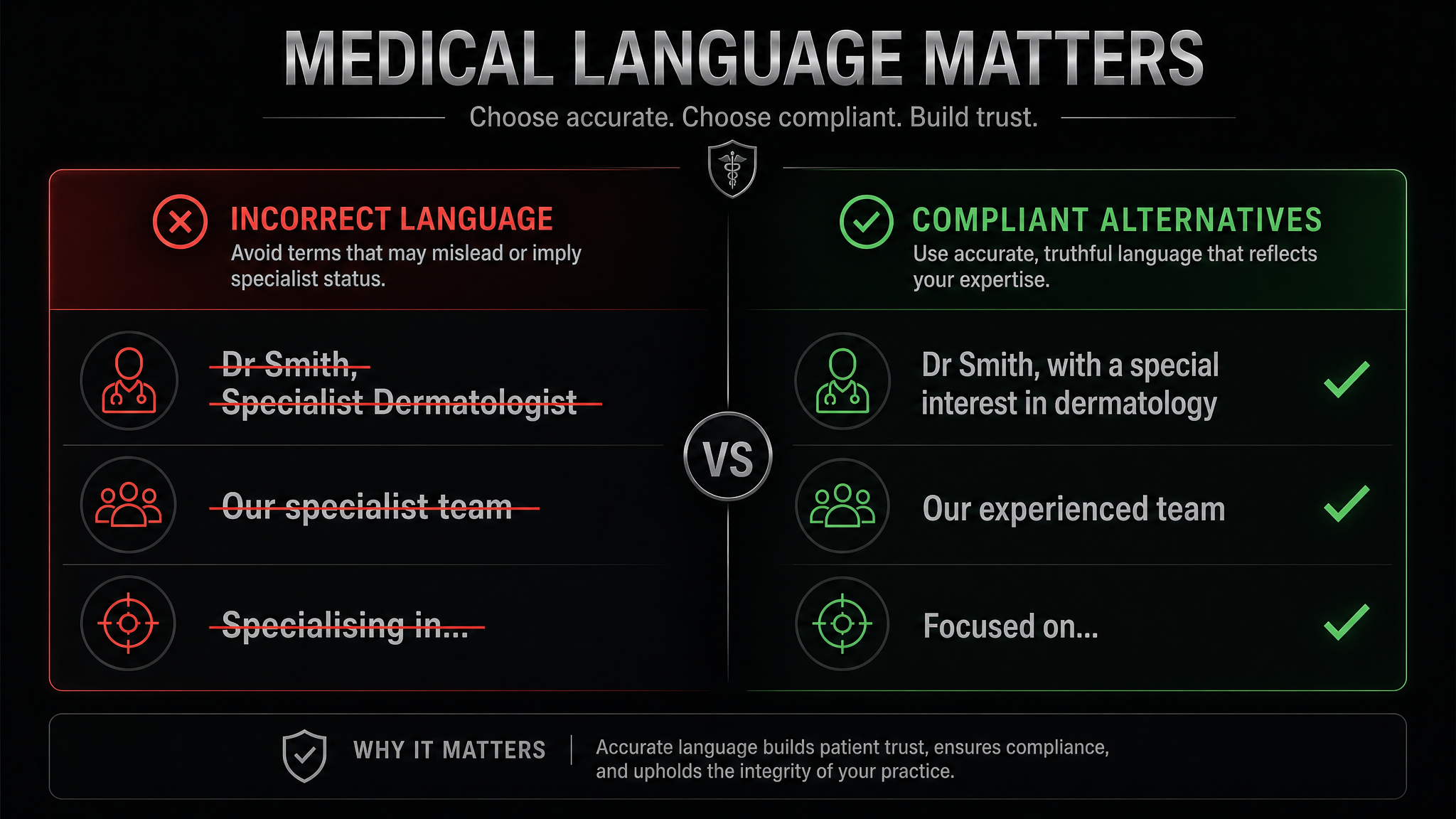
What compliant alternatives can describe practitioner expertise without using 'specialist'?
Compliant alternatives focus on objective, verifiable facts: registration type, qualifications, years of experience, specific training completed, and scope of practice. Use phrases like 'experienced in cosmetic injectables', 'focuses on dermal filler treatments', or 'qualified in advanced aesthetic procedures' — always paired with the practitioner's actual AHPRA registration type (e.g., 'General Practitioner').
Non-Compliant: "Dr Sarah Chen, Cosmetic Surgery Specialist"
Compliant: "Dr Sarah Chen, General Practitioner (MBBS, FACAM), with 12 years' experience in cosmetic injectable treatments"
Why it works: States actual registration type, verifiable qualifications, and experience without implying specialist status.
The key compliance principle is accuracy and verifiability. Every claim in a team bio must be objectively true and able to be verified through AHPRA's public register or the practitioner's qualifications. This approach naturally avoids protected title violations while still communicating expertise.
For nurses and allied health practitioners, the same principle applies. A registered nurse cannot be described as an 'injectable specialist' or 'dermal therapy specialist', but can be accurately described as 'Registered Nurse with Certificate IV in Beauty Therapy and advanced training in cosmetic injectables'.
Effective compliant alternatives include:
- 'Focuses on' or 'specialises in' (lowercase, as a verb describing practice focus, not a title) — e.g., "Dr James Lee specialises in non-surgical facial rejuvenation"
- 'Experienced in' with specific year count — e.g., "15 years' experience in cosmetic dermatology procedures"
- 'Advanced training in' with specific course or qualification — e.g., "Advanced training in dermal filler techniques through the Australasian College of Aesthetic Medicine"
- 'Practice focus' or 'clinical interest' — e.g., "Clinical interest in body contouring and skin tightening procedures"
- Specific procedures performed — e.g., "Performs wrinkle-reducing injections, dermal fillers, and skin needling treatments"
Always pair these descriptors with the practitioner's actual registration type prominently displayed. The reader should never be left uncertain about whether the practitioner is a specialist in the legal sense.
If you're unsure whether your current team bio language complies, our AHPRA advertising compliance checker can scan your team pages and flag protected title violations before they reach AHPRA's attention.
How can you verify if a practitioner genuinely holds specialist registration?
Check the AHPRA public register at ahpra.gov.au/registration — search for the practitioner by name, and their registration record will show 'Registration Type' as either 'Specialist' (with the specific specialty listed) or 'General'/'Non-specialist'. Only practitioners showing 'Specialist' registration can legally use the specialist title.
The AHPRA public register is the single authoritative source for registration verification. It updates in real-time and includes:
- Practitioner's full name and registration number
- Profession (e.g., Medical Practitioner, Nurse, Physiotherapist)
- Registration type (Specialist or General/Non-specialist)
- Specialty field (for specialist registrations only — e.g., Plastic Surgery, Dermatology, Ophthalmology)
- Registration status and expiry date
- Any conditions or restrictions on registration
For medical practitioners, recognised specialist fields include: anaesthesia, dermatology, emergency medicine, general practice (as a specialty), internal medicine, obstetrics and gynaecology, ophthalmology, pathology, paediatrics, psychiatry, radiology, and surgery (with sub-specialties including plastic and reconstructive surgery). Notably, 'cosmetic surgery' is not a recognised specialty — cosmetic procedures are performed by specialists in plastic surgery, dermatology, or other relevant fields.
Myth: Fellowship of a professional college (like FACAM — Fellow of the Australasian College of Aesthetic Medicine) means the practitioner is a specialist.
Reality: Professional college fellowships are valuable qualifications but do not confer specialist registration. Only AHPRA-recognised specialist training programs lead to specialist registration. A GP with FACAM is still a general practitioner, not a specialist, unless they also hold separate specialist registration in a recognised field.
For clinic owners conducting team bio audits, create a verification spreadsheet with each practitioner's name, AHPRA registration number, registration type, and any specialist field. Cross-reference this against your current website language. Any practitioner described with specialist terminology who doesn't show 'Specialist' registration type requires immediate bio revision.
This verification process should be repeated annually, as registration types can change (practitioners may complete specialist training, or registration may lapse). Make AHPRA register verification part of your annual website compliance review.
Our article on AHPRA's cosmetic surgery advertising guidelines provides additional context on how specialist registration requirements interact with cosmetic procedure advertising rules.

What immediate steps should you take if your team bios contain specialist claims?
Immediately remove or revise any team bio that describes a non-specialist practitioner with specialist terminology. Take screenshots of the original content (for your records), update the bios with compliant language using the practitioner's actual registration type and verifiable qualifications, and document the date of correction. This should be completed within 24-48 hours of identification.
- Step 1: Export or screenshot all current team bio pages (website, social media, Google Business Profile, third-party directories)
- Step 2: Verify each practitioner's registration type via AHPRA public register — record registration number and type
- Step 3: Identify any use of 'specialist', 'specialised', 'specialty', or similar terms paired with non-specialist practitioners
- Step 4: Rewrite non-compliant bios using compliant alternatives (experience, focus, training) with actual registration type prominently displayed
- Step 5: Update all platforms simultaneously (website, social media, directories) to ensure consistency
- Step 6: Document the audit date, findings, and corrections in your compliance records
- Step 7: Schedule annual re-verification of all practitioner registration types
Speed matters because every day non-compliant content remains published is a continuing offence. If AHPRA issues a breach notice, they will note the date they first identified the violation and the date of correction — prolonged non-compliance after notification significantly increases penalty risk.
For multi-location clinics or franchises, ensure corrections are applied across all locations and all digital properties. A common error is updating the main website while leaving non-compliant bios on location-specific pages, Google Business Profiles, or third-party directories like HealthEngine or HotDoc.
If you've already received an AHPRA breach notice regarding team bio specialist claims, treat this as urgent. Respond within the specified timeframe (usually 7-14 days) with evidence of correction: screenshots showing before/after content, updated URLs, and a written explanation of the steps taken to prevent recurrence. Failure to respond appropriately can escalate to formal investigation and prosecution.
Consider implementing a pre-publication review process for all new team bios. Before any practitioner bio goes live, it should be verified against AHPRA registration records and reviewed for protected title compliance. Our AHPRA advertising compliance checker can automate this verification step, flagging protected title violations before content is published.
For ongoing monitoring of your entire website — including team pages, service descriptions, and blog content — the website compliance scanner continuously monitors for protected title violations and other AHPRA advertising breaches, alerting you to issues before they reach regulatory attention.
How do protected title rules apply to other health professions beyond medicine?
Protected title rules apply across all 16 AHPRA-regulated professions — including nursing, physiotherapy, dentistry, pharmacy, and psychology. Each profession has specific protected titles (e.g., 'registered nurse', 'physiotherapist', 'dentist') and specialist registration pathways where applicable. Using a protected title without the corresponding registration is an offence regardless of profession.
For dentistry, specialist registration exists in fields including orthodontics, oral surgery, periodontics, and prosthodontics. A general dentist cannot use titles like 'cosmetic dentistry specialist' or 'implant specialist' unless they hold formal specialist registration in a recognised dental specialty. Our article on dental advertising compliance risks explores related compliance issues for dental practices.
For nursing and midwifery, 'nurse practitioner' and 'midwife' are protected titles requiring specific registration. A registered nurse cannot use 'nurse practitioner' unless they hold nurse practitioner registration. Similarly, terms like 'clinical nurse specialist' may be used in employment contexts but should not be used in advertising in ways that imply specialist registration status.
Physiotherapy has specialist registration pathways in sports physiotherapy, musculoskeletal physiotherapy, and other fields. Only physiotherapists with specialist registration can use specialist titles in advertising.
Psychology has specialist registration in clinical psychology, clinical neuropsychology, community psychology, counselling psychology, educational and developmental psychology, forensic psychology, health psychology, organisational psychology, and sport and exercise psychology. A general psychologist cannot advertise as a 'clinical psychologist' or any other specialist type without the corresponding specialist registration.
The principle is consistent across all professions: the AHPRA public register is the authoritative source, and only the registration types shown on that register can be used in advertising and professional communications.
For cosmetic clinics employing multiple professions (doctors, nurses, dermal therapists), ensure your compliance verification process covers all practitioners regardless of profession. Each profession's protected titles and specialist registration pathways must be verified independently.
What role do third-party platforms play in protected title compliance?
Practitioners and clinics remain legally responsible for all content about their services on third-party platforms including Google Business Profile, HealthEngine, HotDoc, social media, and review sites. If your Google Business listing describes a practitioner as a specialist without proper registration, you are liable for that protected title violation even though Google hosts the content.
This responsibility extends to content you cannot directly edit but have influence over. For example, if a patient posts a Google review calling your GP a 'cosmetic surgery specialist', and you respond publicly thanking them for the review without correcting the mischaracterisation, AHPRA may view this as tacit endorsement of the protected title misuse.
The AHPRA Advertising Guidelines make clear that advertising includes any material published or broadcast by any means, and practitioners are responsible for monitoring and correcting third-party content that relates to their services.
High-risk scenario: Your clinic's HealthEngine profile lists Dr James Smith as "Cosmetic Injectable Specialist". A patient finds your clinic through HealthEngine, books a consultation, and later files an AHPRA complaint alleging they were misled about Dr Smith's qualifications when complications arose.
Outcome: AHPRA investigates and finds Dr Smith holds general registration, not specialist registration. The clinic faces penalties for protected title misuse, and the complaint adds weight to the patient's allegations of misleading conduct.
Conduct a comprehensive audit of all third-party platforms where your practitioners are listed:
- Google Business Profile (main listing and individual practitioner profiles if created)
- HealthEngine, HotDoc, and other booking platforms
- Professional directory sites (HealthShare, True Local, etc.)
- Social media profiles (LinkedIn, Instagram, Facebook business pages)
- Industry association directories
- Hospital or clinic network directories
For each platform, verify that practitioner descriptions use only their actual AHPRA registration type and avoid protected title terminology. Update or request corrections where necessary, and maintain records of these updates.
Some platforms allow practitioners to claim and edit their own profiles. Ensure your practitioners understand protected title rules and do not self-describe using specialist terminology on these platforms. Include this in practitioner onboarding and annual compliance training.
Our guide on Google reviews and AHPRA compliance provides detailed guidance on managing third-party content, including patient reviews that may contain non-compliant claims.
- Health Practitioner Regulation National Law — Sections 113-120 (protected titles), Section 133 (advertising offences), effective as consolidated 2024
- AHPRA Advertising Guidelines — Section 2.3 (protected titles in advertising), March 2020 with September 2025 updates
- AHPRA Public Register — Authoritative source for practitioner registration verification
- AHPRA Notifications Process — Enforcement procedures for advertising and protected title breaches
- AHPRA Acceptable Evidence in Health Advertising — Updated guidance on substantiation requirements for claims
Regulations verified current as of 02 June 2026.
This article is for educational purposes only and does not constitute legal or medical advice. Practitioners should consult their legal adviser or AHPRA directly for guidance specific to their circumstances.
Dr Hercules Kollias
AHPRA-registered practitioner · 30 years clinical experience
Founder, The Compliance Scalpel
Dr Kollias built The Compliance Scalpel after three decades of clinical practice — encoding hard-won knowledge of AHPRA and TGA advertising rules into automated compliance tooling for Australian healthcare practitioners.
Check Before You Publish
The Compliance Scalpel audits your healthcare marketing content against AHPRA and TGA guidelines before it goes live. Catch the risks. Cut them out.
Try the Scalpel