Your Before/After Photos Need These Three Disclaimers
Reviewed by Dr Hercules Kollias, AHPRA-registered practitioner · 30 years clinical experience
Who this applies to: Cosmetic injectors, plastic surgeons, dermatologists, dentists, physiotherapists, and any AHPRA-registered practitioner using before/after images to advertise health services
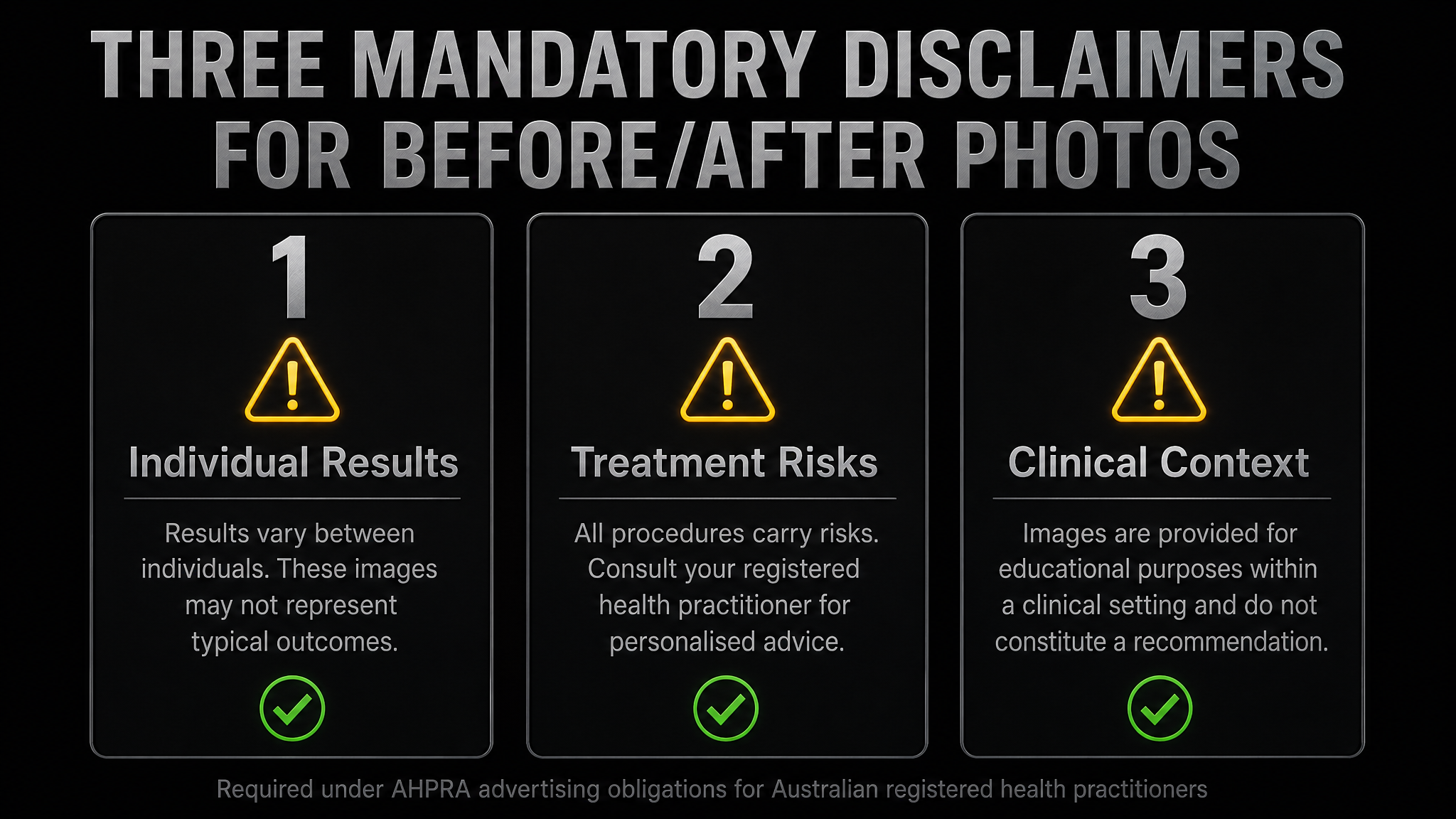
- AHPRA requires three mandatory disclaimers on all before/after photos: treatment nature, individual variation warning, and relevant risks
- Even genuine, unedited photos breach Section 133 if they create unrealistic expectations through missing context
- Instagram, Facebook, and Google Business listings are advertising platforms—social media posts require the same disclaimers as website content
- Penalties reach $60,000 per individual practitioner and $120,000 per corporate entity for non-compliant images
What disclaimers are required on before/after photos under AHPRA guidelines?
Section 9 of the AHPRA Advertising Guidelines mandates three specific disclaimers for all before/after images: (1) a description of the treatment nature and extent, (2) a statement that results vary between individuals, and (3) disclosure of relevant risks associated with the procedure. Without all three elements, the image constitutes a prohibited guarantee of outcome under Section 133 of the National Law.
The AHPRA Advertising Guidelines treat before/after photos as high-risk advertising content because they create powerful visual expectations about treatment outcomes. In plain English, this means every before/after image you publish—whether on Instagram, your website, or a consultation room display—must include contextual information that prevents patients from assuming they will achieve identical results.
The three mandatory disclaimer elements work together to provide informed context:
- Treatment nature: Specify what procedure was performed, including the number of sessions, products used (in category terms only—never name Schedule 4 substances), and timeframe between images
- Individual variation: Explicitly state that outcomes differ between patients based on individual factors such as skin type, age, lifestyle, and baseline condition
- Relevant risks: Disclose material risks associated with the procedure, including common side effects like swelling, bruising, asymmetry, or the need for revision treatments
These requirements apply regardless of image format, platform, or audience size. A single Instagram Story with 50 views carries the same compliance obligation as a billboard campaign.
Why do genuine, unedited photos still breach AHPRA guidelines?
Authenticity alone does not ensure compliance. AHPRA prohibits creating unrealistic expectations about outcomes, which occurs when genuine photos lack contextual disclaimers about treatment specifics, individual variation, and risks. Even a truthful image becomes misleading advertising if it implies a typical or guaranteed result without qualifying information.
This is one of the most misunderstood aspects of cosmetic advertising compliance. Many practitioners believe that as long as photos are unfiltered, unedited, and genuinely show their work, they satisfy regulatory requirements. The reality is more nuanced.
Section 133 of the National Law prohibits advertising that creates an unreasonable expectation of beneficial treatment. In plain English, this means showing only your best outcomes—even if they are completely genuine—creates a false impression of typical results. The dominant impression test under Australian Consumer Law reinforces this: what matters is not whether individual elements are truthful, but whether the overall impression misleads.
Myth: "If I use real patient photos without Photoshop or filters, I'm compliant with AHPRA guidelines."
Reality: Unedited photos still breach Section 133 if they lack the three mandatory disclaimers or create unrealistic expectations by showing only exceptional results. The Medical Board Code of Conduct Section 8.11 explicitly requires that advertising "must not create unreasonable expectations of beneficial treatment." Authenticity addresses only one compliance dimension—context and representativeness matter equally.
Consider a cosmetic injector who posts ten before/after photos showing dramatic lip augmentation transformations. Every photo is genuine. Every photo shows real patients. But if those ten photos represent the best outcomes from 200 treatments, and none include disclaimers about swelling, asymmetry risk, or the fact that results vary significantly based on lip anatomy, the advertising creates a misleading dominant impression.
AHPRA's enforcement approach focuses on whether advertising could mislead a reasonable consumer, not whether the advertiser intended to deceive. This is why contextual disclaimers are mandatory—they counteract the inherent selection bias in before/after galleries.
What happens if AHPRA finds before/after photos without proper disclaimers?
AHPRA can issue formal notifications requiring immediate content removal, impose conditions on your registration restricting advertising activities, refer matters to tribunal for penalties up to $60,000 per individual practitioner or $120,000 per corporation, or in serious cases, suspend registration. Enforcement action typically begins with a complaint-triggered investigation and escalates based on breach severity and practitioner response.
The enforcement pathway typically follows this sequence:
Stage 1: Complaint and investigation. AHPRA receives a complaint about your advertising (often from a dissatisfied patient, competitor, or member of the public). The Advertising Compliance and Enforcement team reviews your content against the Guidelines. You receive a formal notification letter requesting an explanation and evidence of compliance.
Stage 2: Compliance action. If AHPRA determines a breach has occurred, they issue a formal direction to remove or modify the non-compliant content within a specified timeframe (typically 7-14 days). Failure to comply escalates the matter. You may be required to publish a corrective statement or undertake compliance training.
Stage 3: Tribunal referral. For serious breaches, repeated violations, or non-compliance with directions, AHPRA refers the matter to the relevant state or territory tribunal. The tribunal has power to impose financial penalties, registration conditions, or in extreme cases, suspension.
Under the Health Practitioner Regulation National Law (as amended 2022):
- Individual practitioners: up to $60,000 per offence
- Bodies corporate: up to $120,000 per offence
Source: Health Practitioner Regulation National Law and Other Legislation Amendment Act 2022
The "per offence" language is critical. If you have 15 non-compliant before/after photos on your Instagram feed, AHPRA can treat each image as a separate offence. A single social media gallery could theoretically attract penalties exceeding $900,000 for a corporate practice.
Beyond financial penalties, AHPRA notifications appear on the public register, damage professional reputation, increase professional indemnity insurance premiums, and create ongoing compliance obligations including mandatory audits of all advertising materials.
The AHPRA complaints process does not require proof of patient harm—only evidence that advertising breached the Guidelines. This means even if no patient experienced adverse outcomes, your before/after photos can still trigger enforcement action based solely on missing disclaimers.
How should practitioners write compliant before/after photo disclaimers?
Compliant disclaimers must be specific, visible, and proximate to the image. Use plain language to describe the exact treatment performed, explicitly state that individual results vary, and list material risks in clear terms. The disclaimer must appear alongside the image—not buried in a separate terms page or bio section—and be legible on the platform where the image appears.
Here is a compliant disclaimer template that satisfies all three AHPRA requirements:
Treatment: Non-surgical dermal filler treatment to the lips, performed over one session using 1ml of hyaluronic acid filler. Photos taken immediately before treatment and 14 days post-treatment.
Individual results: Outcomes vary significantly between individuals based on factors including lip anatomy, skin type, age, lifestyle, and healing response. The result shown may not be typical or achievable for all patients.
Risks: Common risks include swelling, bruising, asymmetry, lumpiness, and dissatisfaction with aesthetic outcome. Serious but rare risks include vascular occlusion, infection, and allergic reaction. Revision or dissolving treatment may be required.
Note the specificity in each element. The treatment description avoids naming the specific Schedule 4 product (compliant with the September 2025 AHPRA updates prohibiting prescription injectable product naming), but provides enough detail for informed context. The individual variation statement goes beyond a generic "results may vary" to explain why outcomes differ. The risk disclosure covers both common and serious complications.
For platform-specific applications:
Instagram and Facebook posts: Include the full disclaimer in the caption text, not as a comment. Captions are considered part of the advertisement; comments may be overlooked or deleted. If character limits constrain you, prioritise the three mandatory elements over promotional language.
Instagram Stories: Use text overlay on the image itself, or include a follow-up Story slide with the disclaimer. Stories that disappear after 24 hours are still advertising and require full compliance during their visibility period.
Website galleries: Place disclaimers directly beneath each image or use a persistent overlay/modal that appears when users view the image. A single disclaimer at the gallery footer is insufficient—each image must have proximate context.
Google Business listings: Google's photo upload interface does not support captions, making compliant before/after photos nearly impossible on this platform. The safest approach is to avoid before/after images on Google Business entirely, as Google's platform creates multiple compliance risks for cosmetic practitioners.
Visibility matters as much as content. Disclaimers in 6-point grey text on a white background, or hidden behind a "read more" link, fail the proximity and legibility requirements. AHPRA applies a reasonable consumer test: would an ordinary person viewing this content see and understand the qualifying information?
Do disclaimer requirements apply to before/after photos in consultation rooms?
Yes. AHPRA's definition of advertising includes any material that promotes health services, regardless of where it appears. Before/after photos displayed in consultation rooms, reception areas, or shown during patient consultations constitute advertising and require the same three mandatory disclaimers as public-facing content.
This surprises many practitioners who assume that materials shown only to existing patients in private settings fall outside advertising regulation. The National Law defines advertising broadly as "any communication that promotes or is intended to promote health services." In plain English, if you are showing images to encourage patients to proceed with treatment, those images are advertising.
The distinction between "marketing to acquire new patients" and "educating existing patients" is not recognised in AHPRA's framework. A before/after photo shown on an iPad during a consultation to illustrate possible outcomes is advertising just as much as the same photo posted to Instagram.
Practical compliance approaches for consultation room materials:
- Printed portfolios: Include a printed disclaimer page at the start of the portfolio that patients review before viewing images, plus individual disclaimers beneath each photo
- Digital presentations: Embed disclaimer text on each slide containing before/after images, or include a mandatory disclaimer slide that appears before the image gallery
- Wall displays: Mount printed disclaimers in frames adjacent to before/after photos, ensuring text size is legible from typical viewing distance
- Tablet or touchscreen displays: Program disclaimer overlays that appear when users select an image, requiring acknowledgment before viewing
The consultation room context does create one compliance advantage: you can provide verbal context and answer questions in real-time, which helps satisfy the informed decision-making objective underlying the disclaimer requirements. However, verbal explanations do not replace written disclaimers—both are required.
For practitioners concerned about aesthetic impact, consider that well-designed disclaimer cards or overlays can enhance professionalism and demonstrate regulatory diligence. Patients increasingly expect transparency about risks and individual variation; comprehensive disclaimers build trust rather than deterring consultations.
Can practitioners use stock photos or models instead of real patient results?
Stock photos and model images that imply treatment results are explicitly prohibited under Section 133. AHPRA Guidelines state that images must be genuine representations of the practitioner's own work, obtained with proper patient consent. Using stock imagery to suggest outcomes you have achieved constitutes misleading conduct and false representation.
This prohibition extends beyond obvious stock photography to include:
- Manufacturer-supplied images: Photos provided by device or product manufacturers showing results achieved by other practitioners cannot be presented as your work
- Training course materials: Before/after images from training workshops or certification courses do not represent your clinical outcomes
- Purchased image libraries: Commercial before/after photo collections sold to multiple practitioners create false impressions about your specific results
- Colleague or mentor results: Images of work performed by other practitioners, even within your clinic, cannot be attributed to you individually
The authenticity requirement serves two regulatory objectives. First, it ensures advertising reflects your actual skill level and typical outcomes, preventing practitioners from creating false impressions of expertise. Second, it protects patient privacy by requiring explicit consent for each use of patient images.
A cosmetic injector downloads before/after photos from a dermal filler manufacturer's website and posts them to Instagram with the caption "See what's possible with lip enhancement treatments at our clinic." Even though the post does not explicitly claim these are the injector's own results, the dominant impression suggests they represent the clinic's work. This constitutes misleading advertising under both AHPRA Guidelines and Australian Consumer Law Section 18.
The alternative to before/after photos is educational content that does not create outcome expectations. Consider:
- Anatomical diagrams: Illustrations showing how treatments work at a physiological level
- Technique videos: Educational content about injection techniques, product properties, or consultation processes (without showing patient results)
- Practitioner credentials: Information about your training, experience, and qualifications (ensuring compliance with protected title requirements)
- Treatment process explanations: Step-by-step descriptions of what patients can expect during and after procedures
Some practitioners use illustrated "expectation guides" that show a range of possible outcomes from minimal to significant, clearly labelled as illustrations rather than patient photos. While this approach reduces the visual impact compared to before/after photography, it avoids creating false expectations about specific results.
If you choose to use before/after photos, every image must be your own work, obtained with written patient consent that specifically authorises advertising use, and accompanied by the three mandatory disclaimers. There are no compliant shortcuts.
How do the September 2025 AHPRA updates affect before/after photos of cosmetic injectables?
The September 2025 guidelines impose additional restrictions on before/after photos for prescription injectable treatments: practitioners cannot name specific products, use related hashtags, advertise prices, or sexualise/idealise results. Photos must be flagged as adult content on social media platforms, and must not feature individuals under 18 or target minors.
These enhanced requirements reflect AHPRA's increased scrutiny of higher-risk cosmetic procedures, particularly prescription injectable treatments. The changes create several new compliance obligations beyond the three core disclaimers:
Product naming prohibition: You cannot mention brand names, generic names, or slang terms for prescription injectables in captions, hashtags, or image overlays. Refer to treatments only in category terms like "prescription injectable treatments," "wrinkle-reducing injections," or "dermal filler procedures." This applies even within the treatment nature disclaimer—describe what was done without naming specific Schedule 4 substances.
Hashtag restrictions: Hashtags referencing prescription injectable product names or slang terms are prohibited. This includes obvious tags like brand names, but also coded language and abbreviations commonly used in cosmetic advertising. Safe alternatives include #cosmeticinjector, #aestheticmedicine, or #nonsurgicaltreatment.
Price advertising ban: You cannot include pricing information in before/after posts for prescription injectable treatments. This prohibition extends to promotional language like "winter special" or "limited-time pricing." Pricing for these treatments must be discussed in private consultations, not public advertising.
Sexualisation and idealisation: Before/after photos must not present results in a sexualised context or idealise cosmetic enhancement as necessary for attractiveness, success, or social acceptance. Captions should be clinical and educational rather than aspirational or emotionally persuasive. Avoid language like "get your dream lips," "perfect pout," or "confidence boost."
Age restrictions: Images must not feature individuals under 18, and advertising must not target minor audiences. On platforms like Instagram and TikTok, ensure your content is flagged for adult audiences and not promoted to users under 18.
Enhanced risk disclosure: For higher-risk procedures, AHPRA expects more comprehensive risk information including recovery time, revision rates, and practitioner-specific experience data where relevant.
These requirements apply to all advertising platforms, but create particular challenges for visual-focused social media. Many practitioners find that compliant before/after posts for prescription injectables are so text-heavy and restricted that they lose marketing effectiveness, leading some to abandon before/after content entirely in favour of educational material.
For detailed guidance on the September 2025 updates, see AHPRA's updated cosmetic surgery advertising guidelines.
What patient consent is required before using before/after photos in advertising?
Practitioners must obtain specific written consent that explicitly authorises advertising use of patient images, separate from general treatment consent. The consent must identify where and how images will be used, confirm the patient understands images may be publicly accessible indefinitely, and allow the patient to withdraw consent at any time.
Generic consent forms that include a clause about "using photos for educational or promotional purposes" are insufficient. AHPRA expects practitioners to obtain informed, specific consent that addresses:
- Scope of use: Which platforms will display the images (website, Instagram, Facebook, consultation room displays, conference presentations)
- Duration: How long images will remain in use, and the process for requesting removal
- Identifiability: Whether the patient's face will be visible, cropped, or obscured
- Commercial context: That images will be used for advertising purposes to promote your practice
- Withdrawal rights: The patient's right to withdraw consent and request image removal, and any limitations on complete removal (e.g., third-party shares of social media content)
The consent process should occur after treatment is complete and results are stable, not before or during treatment when the patient may feel pressured to agree. Offering incentives (discounts, free products) in exchange for photo consent creates inducement compliance risks and may invalidate the consent as not freely given.
- Provide a separate written consent form specific to advertising use of images
- List all platforms where images will appear (be specific: "Instagram @clinicname, clinic website gallery, consultation room displays")
- Explain that images may be viewed by unlimited public audiences and shared beyond your control
- Confirm the patient has seen the specific images to be used and approves them
- Document that consent was given freely without inducements or pressure
- Include a clear withdrawal process with contact details
- Store signed consent forms securely with patient records
- Review and renew consent annually if images remain in use long-term
Privacy law intersects with advertising regulation here. The Australian Privacy Principles require that collection and use of personal information (including photographs) be transparent, limited to specified purposes, and subject to individual control. Using patient images beyond the scope of consent, or refusing to remove images when consent is withdrawn, breaches both privacy law and professional conduct standards.
Some practitioners implement a tiered consent system: patients can consent to limited use (consultation room only), moderate use (website and consultation room), or broad use (all advertising platforms including social media). This approach respects patient autonomy while providing flexibility for your marketing needs.
If a patient withdraws consent, you must remove their images from all platforms you control within a reasonable timeframe (typically 7-14 days). You cannot be held responsible for third-party shares or archived versions beyond your control, but you must make reasonable efforts to request removal from platforms where you have influence.
For comprehensive compliance support including consent form templates and platform-specific guidelines, consider using an AHPRA advertising compliance checker that validates both content and consent documentation before publication.
- AHPRA Advertising Guidelines — Section 9 (Use of images), effective March 2020 with September 2025 updates for higher-risk cosmetic procedures
- Health Practitioner Regulation National Law — Section 133 (Advertising offences), as amended 2022
- Medical Board of Australia Code of Conduct — Section 8.11 (Advertising), updated with Section 10 professional behaviour provisions
- AHPRA Complaints and Notifications Process — Enforcement procedures and compliance pathways
Regulations verified current as of 02 June 2026.
This article is for educational purposes only and does not constitute legal or medical advice. Practitioners should consult their legal adviser or AHPRA directly for guidance specific to their circumstances.
Dr Hercules Kollias
AHPRA-registered practitioner · 30 years clinical experience
Founder, The Compliance Scalpel
Dr Kollias built The Compliance Scalpel after three decades of clinical practice — encoding hard-won knowledge of AHPRA and TGA advertising rules into automated compliance tooling for Australian healthcare practitioners.
Check Before You Publish
The Compliance Scalpel audits your healthcare marketing content against AHPRA and TGA guidelines before it goes live. Catch the risks. Cut them out.
Try the Scalpel