Bulk Billing Claims: AHPRA Advertising Compliance Guide
Reviewed by Dr Hercules Kollias, AHPRA-registered practitioner · 30 years clinical experience
Who this applies to: General practitioners, GP clinic owners, medical centres, allied health practices, physiotherapists, psychologists, and any AHPRA-registered practitioner or healthcare business advertising billing arrangements or fee structures to attract patients.
- Any bulk billing claim with conditions or limitations must disclose those specific eligibility criteria upfront, or the advertising breaches AHPRA Guidelines section 4.3 and Australian Consumer Law section 18.
- Unqualified claims like "Bulk Billing Available" or "No Out-of-Pocket Costs" create a misleading overall impression even if technically true for some patients, triggering penalties up to $60,000 for individual practitioners and $120,000 for bodies corporate.
- AHPRA complaints about billing advertising have increased 34% since 2022, with fee-related complaints now the third most common category after testimonials and unsubstantiated claims.
- Google Business Profiles, social media posts, and third-party directory listings are all considered "advertising" under Section 133 of the National Law and must comply with the same disclosure standards as your website.
What qualifies as misleading bulk billing advertising under AHPRA guidelines?
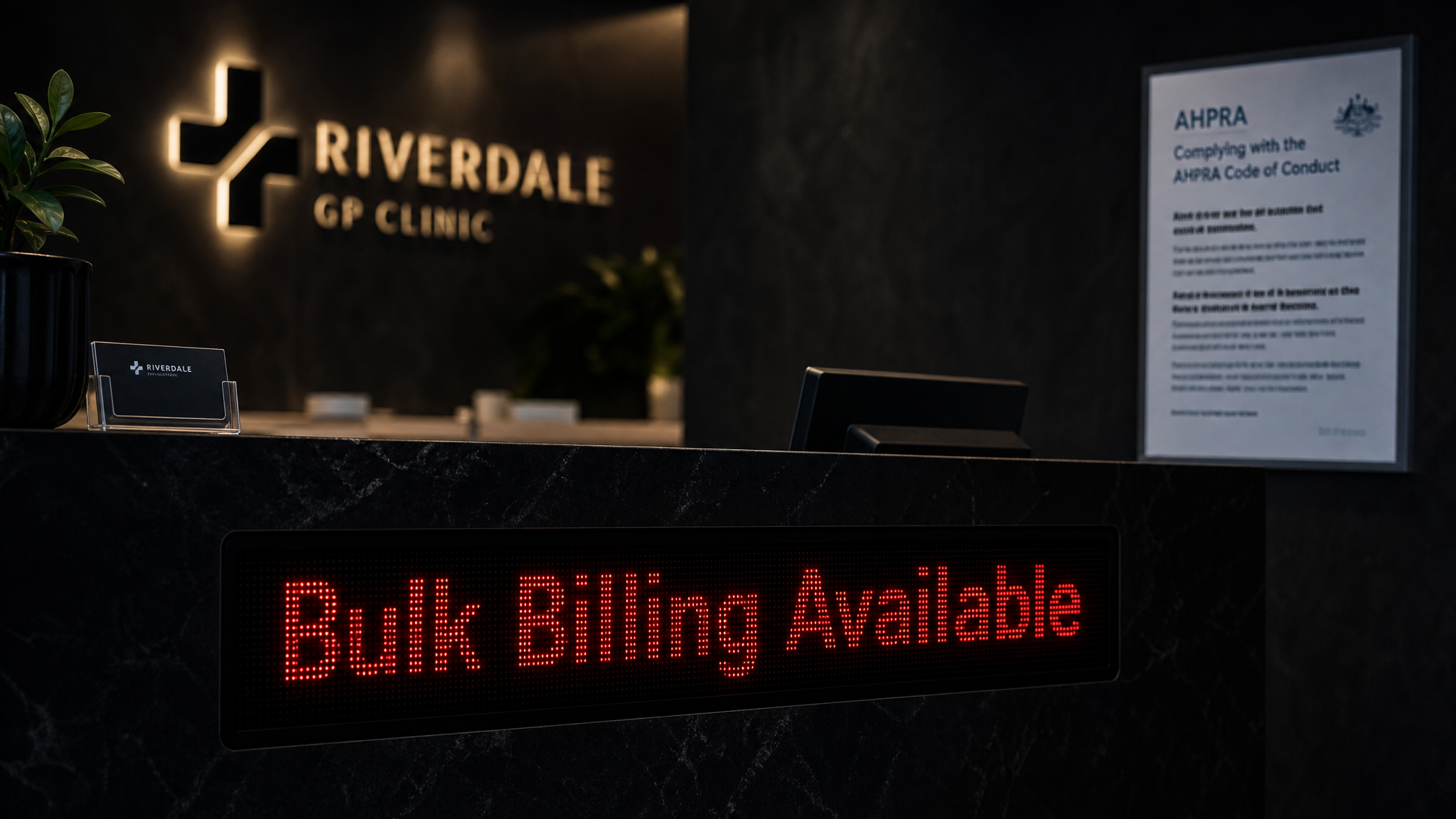
Bulk billing advertising becomes misleading when it creates an overall impression that all patients will be bulk billed, but conditions, limitations, or eligibility criteria apply that aren't clearly disclosed upfront. Under AHPRA Advertising Guidelines section 4.3 and Australian Consumer Law section 18, even technically true statements breach regulations if the dominant impression deceives patients about out-of-pocket costs.
The regulatory test is not whether your claim is literally accurate for some subset of patients. The test is whether a reasonable patient viewing your advertising would form an incorrect expectation about their likely out-of-pocket costs. This is called the "dominant impression test" under Australian Consumer Law, and it applies equally to AHPRA advertising compliance.
Section 4.3 of the AHPRA Advertising Guidelines specifically addresses information about fees and states that advertising must not be false, misleading or deceptive about the cost of services. In plain English, this means if you advertise bulk billing but only bulk bill certain patient categories, you must state those categories clearly in the same advertisement, with equal prominence.
The Australian Competition and Consumer Commission (ACCC) applies the same standard under Australian Consumer Law section 18, which prohibits misleading or deceptive conduct in trade or commerce. In plain English, this means your advertising cannot create a false impression, even if individual statements within it are technically true.
Myth: "We're safe because we do bulk bill some patients, so the claim 'Bulk Billing Available' is technically true."
Reality: Under the dominant impression test, a claim is assessed by the overall impression it creates in the mind of a reasonable consumer, not by whether isolated words are literally accurate. If most patients viewing your "Bulk Billing Available" claim would reasonably expect to be bulk billed themselves, but in reality only 20% of your patients qualify, the advertising is misleading regardless of technical accuracy.
AHPRA's updated enforcement strategy, released in late 2025, specifically identifies fee advertising as a compliance priority following a surge in patient complaints. The regulator now actively monitors Google Business Profiles, social media advertising, and healthcare directory listings for unqualified bulk billing claims.
Consider the patient journey: a prospective patient searches "bulk billing GP near me", finds your Google Business Profile with "Bulk Billing Available" prominently displayed, books an appointment, then discovers at reception they don't qualify and face a $95 gap fee. That patient experience demonstrates the misleading nature of the advertising, even if you technically do bulk bill pensioners.
What specific disclosures must accompany bulk billing claims?
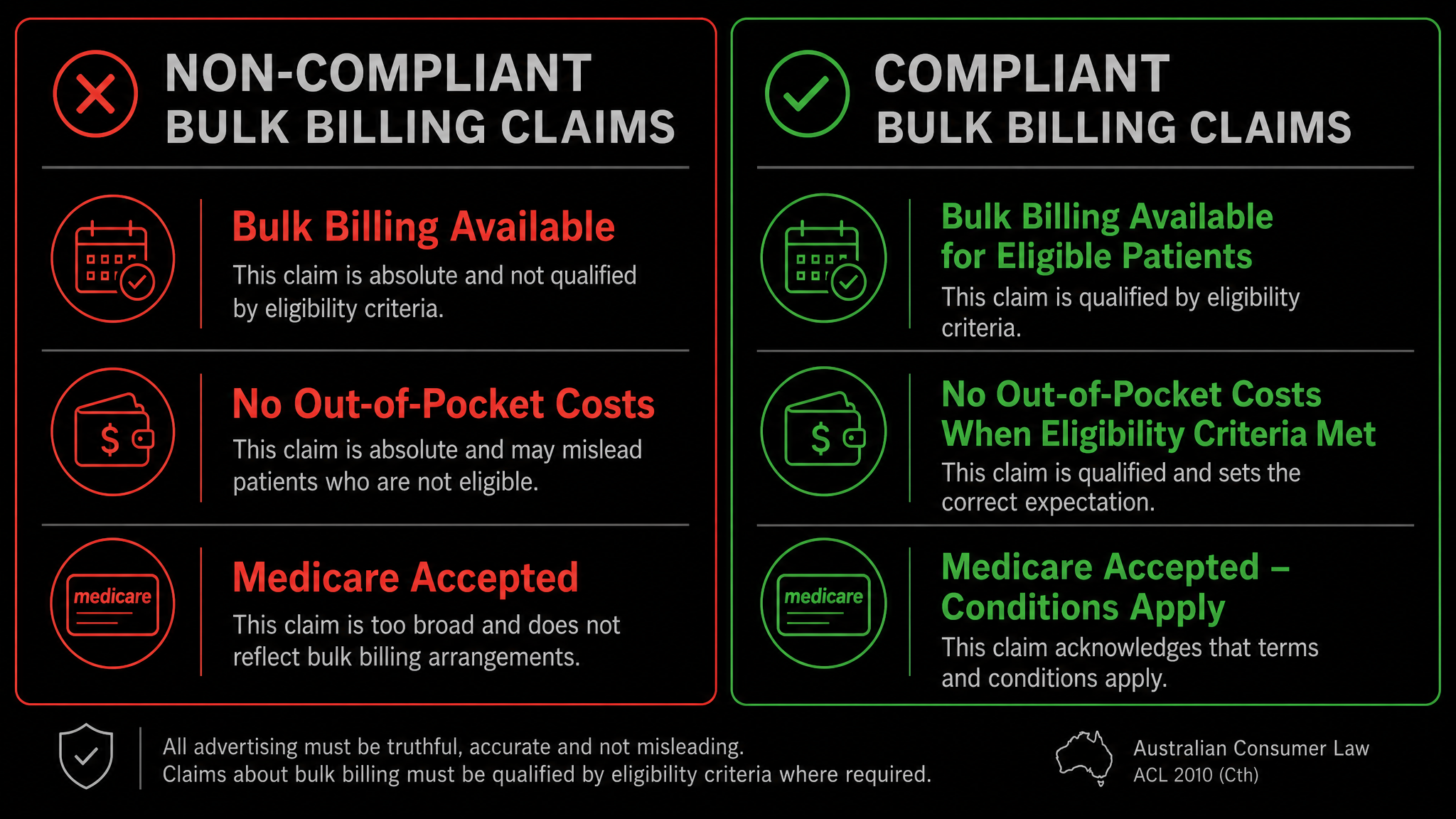
Bulk billing claims must include specific eligibility criteria in the same advertisement, with equal prominence to the bulk billing claim itself. This means stating which patient categories qualify (e.g., "pensioners, healthcare card holders, and children under 16") and what fees apply to other patients. Generic disclaimers like "conditions apply" or "ask reception" do not satisfy disclosure requirements.
The disclosure must be sufficiently specific that a prospective patient can self-assess their likely eligibility before booking an appointment. Vague qualifiers fail this test. Let's examine compliant versus non-compliant disclosure approaches:
- "Bulk Billing Available" (no qualification)
- "No Gap Fees for Eligible Patients" (doesn't define eligible)
- "Medicare Bulk Billing — Conditions Apply" (doesn't state conditions)
- "Bulk Billing Available* (*see reception for details)" (requires patient to inquire, doesn't allow pre-assessment)
- "No Out-of-Pocket Costs" appearing in large font, with "for concession card holders" in fine print
- "We bulk bill pensioners, healthcare card holders, and children under 16. Standard consultation fees apply for other patients (from $95)."
- "Bulk billing available for DVA Gold Card holders and patients with chronic disease management plans. Please contact our reception team to confirm your eligibility and current fees."
- "We bulk bill all patients for telehealth consultations. In-person consultations: bulk billing for concession card holders, $85 gap fee for other patients."
- "Medicare billing available. Bulk billing eligibility: Commonwealth Seniors Health Card holders, pensioners, children under 12. Other patients: $110 consultation fee, Medicare rebate $41.40, out-of-pocket cost $68.60."
Notice the compliant examples provide sufficient information for a patient to determine their likely eligibility and out-of-pocket costs before booking. This is the regulatory standard: the advertising must enable informed decision-making without requiring the patient to make contact first.
The disclosure must also have "equal prominence" to the bulk billing claim. If "Bulk Billing Available" appears in 48-point font in your website header, you cannot satisfy disclosure requirements with 10-point font fine print at the footer. The eligibility criteria must appear immediately adjacent to the claim, in comparable font size and visual weight.
For Google Business Profiles, this creates practical challenges because character limits restrict how much information you can include in the business description. The compliant approach is either to provide a complete, specific disclosure within the character limit, or to remove bulk billing claims from your Google Business Profile entirely and address billing only on your website where you have space for proper disclosure.
Similar considerations apply to social media advertising. A Facebook ad claiming "Bulk Billing Available — Book Now" without eligibility criteria in the ad creative itself is non-compliant, even if your website has proper disclosures. Each advertisement must be independently compliant; you cannot rely on disclosures located elsewhere.
What penalties apply to misleading bulk billing advertising?
Misleading bulk billing advertising can trigger penalties under three separate regulatory frameworks: AHPRA (up to $60,000 for individuals, $120,000 for bodies corporate per offence), Australian Consumer Law (up to $2.5 million for individuals, $50 million for corporations), and state-based fair trading legislation. AHPRA complaints can also trigger Medical Board investigations that may result in conditions on registration, suspension, or cancellation.
Under the Health Practitioner Regulation National Law (as amended 2022):
- Individual practitioners: up to $60,000 per offence
- Bodies corporate: up to $120,000 per offence
Under Australian Consumer Law (Competition and Consumer Act 2010, Schedule 2):
- Individual practitioners: up to $2,500,000
- Bodies corporate: up to $50,000,000
Source: Health Practitioner Regulation National Law and Other Legislation Amendment Act 2022; Competition and Consumer Act 2010
The penalty framework operates on a "per offence" basis, meaning each instance of non-compliant advertising constitutes a separate offence. If your website homepage, Google Business Profile, Facebook page, and HealthEngine listing all contain the same misleading bulk billing claim, that's potentially four separate offences, each carrying the maximum penalty.
AHPRA's enforcement approach prioritises advertising that affects vulnerable populations or creates significant patient harm. Misleading fee advertising falls squarely within this priority category because it disproportionately affects patients from lower socioeconomic backgrounds who specifically seek bulk billing services to avoid out-of-pocket costs they cannot afford.
Beyond financial penalties, misleading advertising complaints frequently trigger broader investigations into a practitioner's conduct. The Medical Board of Australia Code of Conduct section 8.6 specifically addresses advertising and states that doctors must ensure their advertising is accurate and does not exploit patients' vulnerability or lack of medical knowledge. In plain English, this means a single advertising complaint can escalate into a conduct investigation examining your broader practice patterns.
For corporate entities operating multiple clinic locations, the penalty exposure multiplies significantly. A corporate group operating 15 GP clinics with identical misleading bulk billing claims across all locations could face 15 separate corporate penalties of up to $120,000 each, totalling $1.8 million in potential AHPRA penalties alone, before considering Australian Consumer Law exposure.
The Australian Competition and Consumer Commission has concurrent jurisdiction over healthcare advertising under Australian Consumer Law, and while ACCC enforcement actions against individual GP clinics are relatively rare, the regulator does pursue cases involving corporate healthcare providers, particularly where misleading fee advertising affects large numbers of consumers across multiple locations.
Importantly, penalties are not the only consequence. Practitioners subject to AHPRA notifications must disclose this fact when applying for medical indemnity insurance, and insurers may increase premiums or impose exclusions. The notification also becomes part of your permanent AHPRA record and may be disclosed on the public register depending on the outcome.
How do Google reviews and third-party listings affect bulk billing advertising compliance?
Practitioners and clinic owners are responsible for advertising content on platforms they control or can reasonably moderate, including Google Business Profiles, HealthEngine, HotDoc, and other third-party directories. If your directory listing claims "Bulk Billing Available" without qualification, you are responsible for that advertising even though the listing appears on a third-party platform. You cannot delegate compliance responsibility to the directory operator.
This principle extends to Google reviews and patient comments on third-party platforms. While you cannot control what patients write in reviews, you can and must control the business information you provide to these platforms. If you have claimed your Google Business Profile (and most practices have), you control the business description, services list, and attributes — all of which constitute advertising under Section 133 of the National Law.
Many GP clinics inadvertently create compliance exposure through third-party directory listings they established years ago and haven't reviewed since. A common scenario: a practice initially bulk billed all patients, created listings on HealthEngine, HotDoc, and Google with "Bulk Billing Available", then changed their billing policy to bulk bill only concession card holders, but never updated the directory listings. Those outdated listings continue to generate misleading advertising exposure.
- Search Google for your practice name and review your Google Business Profile business description and services list
- Log into HealthEngine, HotDoc, and any other directories where you have a listing
- Review the billing information displayed on each platform
- Check whether any platform lists "Bulk Billing" as a service or feature without qualification
- Update or remove bulk billing claims on every platform where your current eligibility criteria aren't clearly disclosed
- Set a calendar reminder to review all third-party listings quarterly, as these platforms frequently change their interface and may reset your information during updates
Google Business Profiles present particular compliance challenges because the platform encourages businesses to select from pre-defined attributes and services. "Bulk billing" often appears as a selectable attribute, which when selected, displays prominently in your business profile without any opportunity to add qualifying text immediately adjacent to the attribute. If your bulk billing has any conditions or limitations, the safest approach is not to select this attribute at all, and instead address billing only in your business description where you can provide proper context.
Some practitioners attempt to address this by responding to Google reviews with clarifying information about billing policies. This approach does not satisfy compliance requirements. A response to a review is not "equally prominent" to a business attribute or service listing, and prospective patients searching for bulk billing services will see the attribute before they read through review responses.
The AHPRA advertising compliance framework makes no distinction between advertising you publish directly on your own website and advertising you publish through third-party platforms. Both are "advertising" as defined in the National Law, and both must comply with the same standards. As noted in our related article on Google reviews and AHPRA penalties, practitioners must actively manage and moderate content on platforms they control.
For practices using online booking platforms integrated with third-party directories, there's an additional compliance consideration: if the booking flow allows patients to select "bulk billing" as their payment preference without any eligibility screening, and the patient only discovers they don't qualify when they arrive for their appointment, this creates the same misleading patient experience that triggers complaints, even if your advertising technically includes proper disclosures. The entire patient journey must align with your advertising claims.
What about promotional offers and new patient discounts combined with bulk billing claims?
Combining bulk billing claims with promotional offers ("Bulk Billing Plus Free Health Check") or new patient incentives creates additional compliance complexity under AHPRA Guidelines section 4.4, which prohibits offers or inducements that encourage inappropriate or unnecessary use of health services. Any promotional offer must include complete terms and conditions, cannot create pressure to use services, and cannot be framed in a way that trivialises health services.
Section 4.4 of the AHPRA Advertising Guidelines specifically addresses offers and inducements. In plain English, this means you cannot use discounts, gifts, or promotional offers to encourage patients to use health services they don't need, or to create a sense of urgency that prevents informed decision-making.
Bulk billing itself is not an "inducement" in the regulatory sense — it's simply a billing arrangement permitted under Medicare. However, the way you advertise bulk billing can cross into inducement territory. Consider these examples:
- "Limited Time: Bulk Billing for All Patients This Month Only" (creates urgency, encourages unnecessary appointments)
- "Bulk Billing Plus Free Skin Check — Book Today!" (the "free" skin check may encourage patients who don't need screening to book appointments)
- "New Patients: First Consultation Bulk Billed + Free Prescription Review" (combines bulk billing with an additional "free" service that may be unnecessary)
- "Bulk Billing Available — Why Pay Gap Fees Elsewhere?" (comparative claim that may be misleading, implies superiority)
The concern is not bulk billing itself, but rather promotional framing that may encourage indiscriminate use of services. A patient who books a GP appointment primarily because of a "limited time" bulk billing promotion, rather than because they have a genuine health concern, represents the type of inappropriate service utilisation the guidelines aim to prevent.
This issue intersects with our previous analysis of free consultation offers and inducement compliance. The same principles apply: any offer must be presented in a way that supports informed decision-making rather than creating pressure or urgency.
For practices that genuinely want to improve access for specific patient populations, the compliant approach is to state your billing policy clearly without promotional framing: "We bulk bill all patients with chronic disease management plans to improve access to ongoing care" is materially different from "Limited spots: Bulk billing available for chronic disease patients — book now before spots fill!"
New patient promotions require particular care. Many practices offer bulk billing for initial consultations to attract new patients, then charge gap fees for subsequent visits. This is permissible, but the advertising must make the distinction crystal clear: "New patients: first consultation bulk billed. Subsequent consultations: $95 fee, Medicare rebate $41.40, out-of-pocket cost $68.60." Without this disclosure, patients reasonably expect ongoing bulk billing, and complaints follow.
Clear disclosure example: "New patient appointments: We bulk bill your first consultation to ensure cost is not a barrier to establishing care. Ongoing appointments are charged at our standard consultation fee of $95 (Medicare rebate $41.40, typical out-of-pocket cost $68.60). Pensioners and healthcare card holders continue to be bulk billed for all appointments."
This disclosure allows prospective patients to understand the complete fee structure before booking, preventing the misleading impression that all future appointments will be bulk billed.
How should telehealth bulk billing be advertised differently from in-person consultations?
If your bulk billing policy differs between telehealth and in-person consultations, your advertising must clearly distinguish between the two service types and specify which billing arrangement applies to each. Advertising "Bulk Billing Available" without specifying that it applies only to telehealth (or only to in-person) creates a misleading impression when patients discover different fees apply to their preferred consultation type.
The rapid expansion of telehealth during 2020-2022 created widespread confusion about billing arrangements, and many practices now maintain different fee structures for telehealth versus in-person consultations. Common scenarios include:
- Bulk billing all telehealth consultations but charging gap fees for in-person appointments
- Bulk billing in-person consultations for concession card holders but charging all patients for telehealth
- Bulk billing both service types for some patient categories but not others
- Different gap fee amounts for telehealth versus in-person consultations
Each of these scenarios requires specific disclosure in your advertising. A patient who sees "Bulk Billing Available" on your website, books a telehealth appointment expecting no out-of-pocket cost, then receives an invoice for a $65 gap fee has experienced misleading advertising, even if you do bulk bill in-person consultations.
The disclosure must be sufficiently prominent that patients encounter it before selecting their consultation type. If your online booking system allows patients to choose between telehealth and in-person appointments, the fee information for each option must be displayed at the point of selection, not buried in terms and conditions or FAQs.
Website example:
"Telehealth consultations: Bulk billed for all patients.
In-person consultations: Bulk billed for pensioners, healthcare card holders, and children under 16. Other patients: $95 consultation fee (Medicare rebate $41.40, out-of-pocket cost $68.60)."
This format allows patients to immediately understand the fee implications of their consultation type choice.
Some practices have attempted to use telehealth bulk billing as a competitive differentiator, advertising "100% Bulk Billed Telehealth" prominently while maintaining gap fees for in-person consultations. This is permissible provided the distinction is clear, but problems arise when the in-person fee structure isn't disclosed with equal prominence.
A compliant approach might feature telehealth bulk billing in your primary website messaging, but must include in-person fee information in the same section, with comparable visual weight. A non-compliant approach would feature telehealth bulk billing in large font in your header, with in-person fees mentioned only in a footer link to a separate fees page.
For practices using third-party telehealth platforms or apps, remember that any advertising content you provide to these platforms remains your responsibility. If you list your practice on a telehealth directory with "Bulk Billing" selected as an attribute, and the platform doesn't provide a mechanism to specify that this applies only to telehealth consultations, you should not select that attribute. The platform's limitations do not excuse non-compliant advertising.
What about Medicare-ineligible patients and international visitors?
Advertising "Bulk Billing Available" or "Medicare Billing" is inherently misleading to Medicare-ineligible patients including international students, temporary visa holders, and international visitors. If your practice serves a patient population that includes Medicare-ineligible individuals, your fee advertising must clearly state that bulk billing applies only to Medicare-eligible patients and specify fees for Medicare-ineligible consultations.
This issue particularly affects practices located near universities with large international student populations, practices in tourist areas, and practices that specifically market to temporary visa holders. A significant proportion of these patients may not understand the Medicare eligibility system, and advertising that mentions "bulk billing" without clarifying Medicare eligibility requirements creates a misleading impression.
The regulatory concern is heightened because Medicare-ineligible patients are often from non-English-speaking backgrounds and may have limited familiarity with the Australian healthcare system. Advertising that exploits this information asymmetry is precisely the type of conduct AHPRA prioritises in enforcement.
Example for practices serving international students:
"Medicare-eligible patients: We bulk bill pensioners, healthcare card holders, and children under 16. Other Medicare-eligible patients: $95 consultation fee (Medicare rebate $41.40, out-of-pocket cost $68.60).
International students and Medicare-ineligible patients: Standard consultation fee $150 (no Medicare rebate available). We provide receipts for private health insurance claims and OSHC claims."
This disclosure ensures all patient populations can determine their likely out-of-pocket costs before booking.
Some practices attempt to address this by including a general statement like "Medicare required" or "Medicare card must be presented", but this is insufficient. Medicare-ineligible patients may not understand what this means for their out-of-pocket costs, and the statement doesn't provide the fee information they need to make an informed decision.
For practices that advertise in languages other than English, all fee disclosures must be translated accurately and appear in every language version of your advertising. You cannot provide detailed fee information in your English advertising but omit it from Chinese, Arabic, or other language versions. Each language version must be independently compliant.
This principle extends to verbal advertising and community outreach. If your practice participates in international student orientation events or community information sessions for new migrants, any verbal statements about billing arrangements must include the same qualifications and disclosures required in written advertising. Staff members representing your practice at these events should be trained on compliant communication about fees.
What immediate steps should practices take now to achieve compliance?
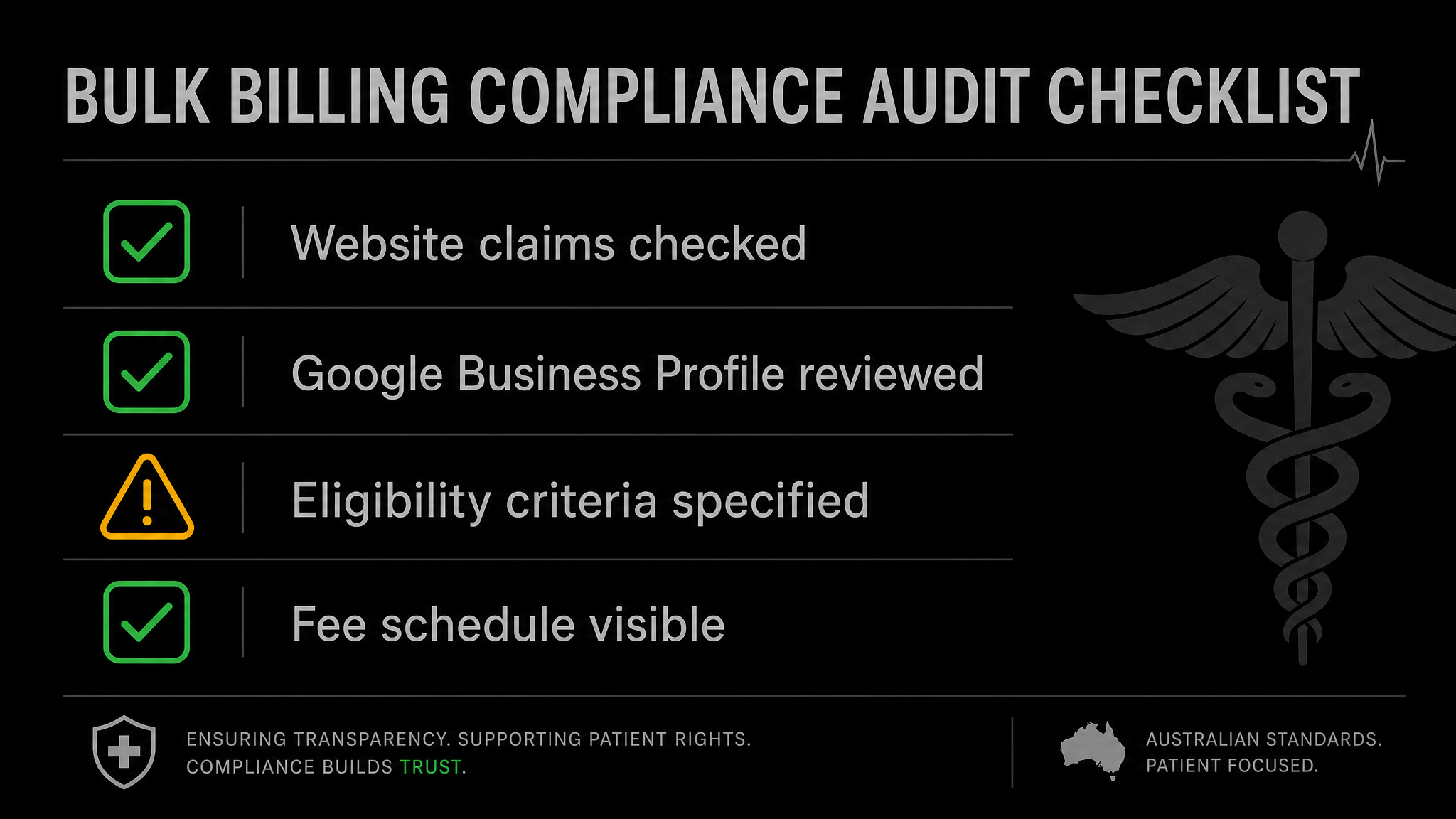
Conduct a complete audit of every platform where your practice appears (website, Google Business Profile, social media, third-party directories) and identify all instances of bulk billing claims. For each instance, either add specific eligibility criteria with equal prominence to the claim, or remove the bulk billing claim entirely. This audit should be completed within 7 days to minimise ongoing exposure to complaints and penalties.
The audit process should be systematic and documented. Create a spreadsheet listing every platform where your practice has a presence, the current billing claims on each platform, and the corrective action required. This documentation serves two purposes: it ensures comprehensive remediation, and it demonstrates good-faith compliance efforts if a complaint is made during the remediation period.
Day 1-2: Identify all advertising instances
- Website (homepage, services pages, about page, footer)
- Google Business Profile (business description, services, attributes)
- Facebook, Instagram, LinkedIn business pages
- HealthEngine, HotDoc, and other directory listings
- Email signatures and automated email responses
- Print materials (brochures, business cards, posters in waiting room)
- Third-party content (sponsor listings, community directory entries)
Day 3-4: Assess compliance of each instance
- Does the claim specify exactly which patient categories qualify for bulk billing?
- Is the eligibility criteria equally prominent to the bulk billing claim?
- Can a prospective patient self-assess their eligibility from the information provided?
- Are fees for non-bulk-billed patients clearly stated?
- If telehealth and in-person have different billing, is this distinction clear?
- Are Medicare-ineligible patient fees disclosed?
Day 5-6: Implement corrections
- Update website content with compliant disclosures
- Revise Google Business Profile description
- Update or delete social media posts containing non-compliant claims
- Log into all third-party directories and update billing information
- Replace print materials containing non-compliant claims
Day 7: Verify and document
- Review all platforms to confirm updates are live
- Take screenshots of corrected advertising for your compliance records
- Brief reception staff on the updated billing disclosures so verbal communication aligns with advertising
- Set quarterly calendar reminder to re-audit all platforms
For corporate groups operating multiple locations, this process must be replicated for each location's individual online presence. Many corporate practices maintain location-specific Google Business Profiles, Facebook pages, and website pages, each of which requires individual remediation.
During the audit, you may discover advertising content you didn't create or don't control. For example, a community organisation might list your practice in their directory with "bulk billing available" based on outdated information. You should contact these organisations and request correction or removal, and document your request. While you're not directly responsible for advertising you didn't create and can't control, demonstrating proactive efforts to correct third-party content shows good faith if a complaint arises.
The audit should also review your online booking system and appointment confirmation emails. If your booking confirmation email states "This is a bulk billed appointment" for all patients, but some patients will actually be charged gap fees, this creates a misleading impression even if your website advertising is compliant. The entire patient communication journey must be consistent with your billing policy.
For practices uncertain about their current bulk billing policy or considering changes to their policy, this audit provides an opportunity to clarify and document your policy before updating advertising. Your billing policy should be documented in writing, specify exactly which patient categories qualify for bulk billing, and be communicated to all staff members who discuss fees with patients.
Practices can use tools like the AHPRA advertising compliance checker to assess website content before publication, and the website compliance scanner to identify potential issues across your existing web presence. For ongoing monitoring of third-party platforms and directory listings, automated compliance monitoring helps identify when platforms change your listing information or when non-compliant content appears.
How do recent regulatory updates affect bulk billing advertising?
AHPRA's updated "Acceptable evidence in health advertising" guidance (released late 2025) and the new "Advertising compliance and enforcement strategy" both emphasise that fee advertising must be substantiated and not misleading. The enforcement strategy specifically identifies fee-related complaints as a priority area, with AHPRA now taking a more proactive approach to monitoring bulk billing claims across digital platforms including Google and social media.
The updated guidance documents released in late 2025 don't create new substantive requirements for bulk billing advertising, but they signal a shift in AHPRA's enforcement priorities and approach. The regulator is moving from reactive complaint-based enforcement to proactive monitoring of digital advertising channels.
This means AHPRA compliance officers are now actively searching for non-compliant advertising on Google Business Profiles, healthcare directories, and social media, rather than waiting for patient complaints. Practices with unqualified bulk billing claims on these platforms face higher detection risk than in previous years.
The updated enforcement strategy also clarifies that AHPRA will consider the cumulative impact of advertising across multiple platforms when assessing penalties. A practice with the same misleading bulk billing claim on their website, Google Business Profile, Facebook page, and three directory listings may face higher penalties than a practice with a single instance of non-compliant advertising, because the multi-platform presence affects more prospective patients.
Additionally, the updated Medical Board of Australia Code of Conduct now includes enhanced provisions in Section 10 regarding professional behaviour and conflicts of interest. While these provisions don't directly address advertising, they establish a broader context for assessing whether fee advertising exploits patients' vulnerability or lack of medical knowledge.
The updated evidence standards guidance reinforces that any claim in health advertising — including claims about fees and billing arrangements — must be substantiated. For bulk billing advertising, this means you must be able to demonstrate that your actual billing practices align with your advertising claims. If you advertise bulk billing for "children under 16" but your practice management system shows you've charged gap fees to children under 16, this creates substantiation issues
Dr Hercules Kollias
AHPRA-registered practitioner · 30 years clinical experience
Founder, The Compliance Scalpel
Dr Kollias built The Compliance Scalpel after three decades of clinical practice — encoding hard-won knowledge of AHPRA and TGA advertising rules into automated compliance tooling for Australian healthcare practitioners.
Is Your Website Compliant Right Now?
The Compliance Sentinel continuously monitors your practice website for AHPRA and TGA advertising risks — so you know the moment something needs attention.
Learn About Sentinel