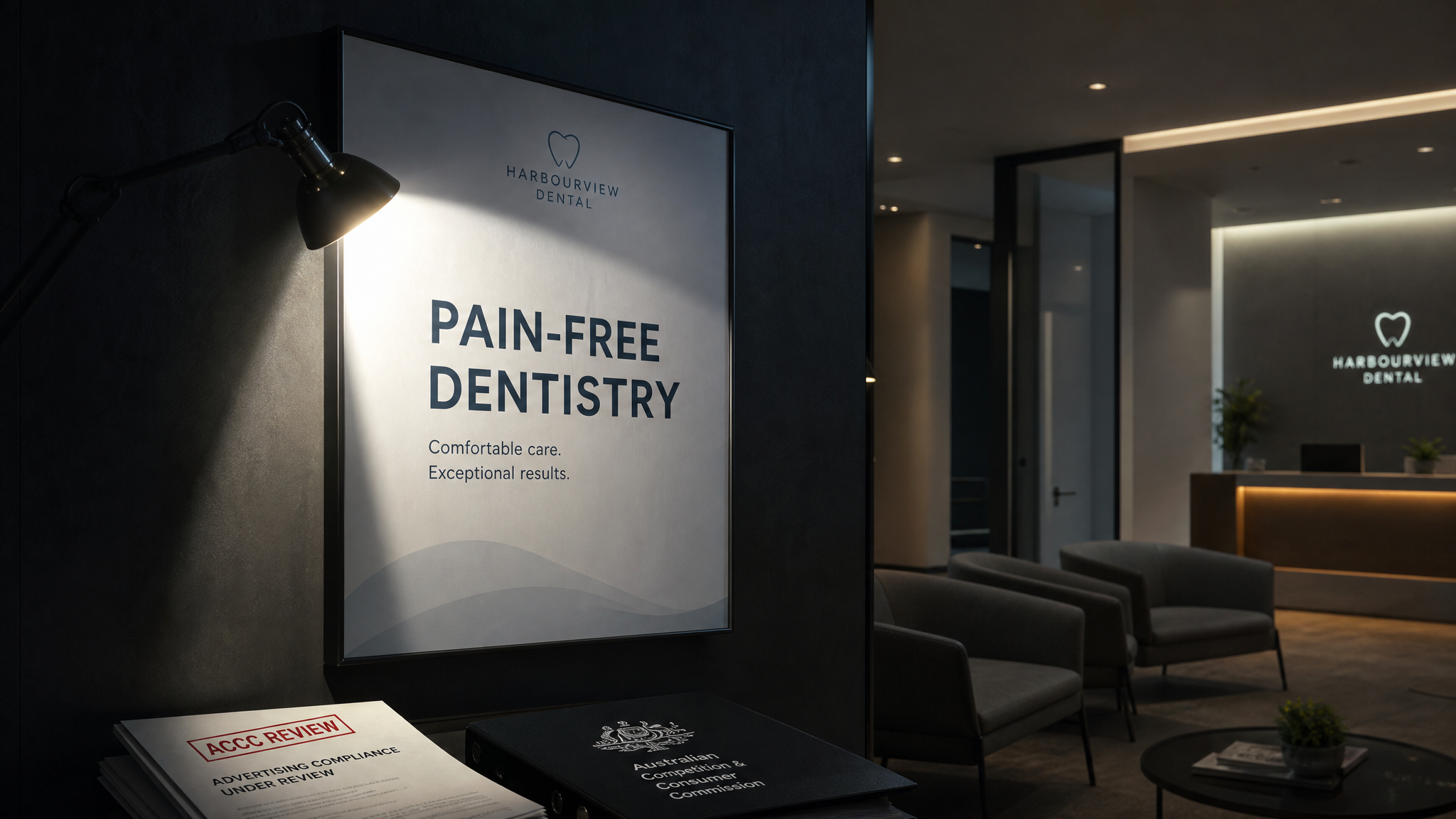
Your 'Pain-Free' Service Claims Risk AHPRA Action
Reviewed by Dr Hercules Kollias, AHPRA-registered practitioner · 30 years clinical experience
Who this applies to: AHPRA-registered dentists, dental specialists, physiotherapists, chiropractors, osteopaths, cosmetic injectors, dermatologists, and any health practitioner advertising treatment comfort or pain management outcomes
- Absolute comfort claims like 'pain-free', 'zero discomfort', or '100% comfortable' constitute prohibited outcome guarantees under AHPRA Guidelines Section 3.2
- Pain experience is subjective and varies by individual pain threshold, anxiety levels, and physiological factors — no practitioner can guarantee an outcome they cannot control
- Trigger words including 'completely', 'guarantee', 'always', 'never', and '100%' transform legitimate comfort descriptions into non-compliant absolute promises
- Penalties reach $60,000 per offence for individual practitioners and $120,000 for corporate entities under 2022 amendments to the National Law
Why do 'pain-free' treatment claims breach AHPRA advertising guidelines?
Claims describing treatments as 'pain-free', 'completely comfortable', or guaranteeing 'zero discomfort' violate Section 3.2 of the AHPRA Advertising Guidelines because they constitute guarantees of therapeutic outcomes that practitioners cannot control. Pain perception is inherently subjective and varies between individuals based on pain threshold, anxiety levels, medical history, and physiological factors.
The AHPRA Advertising Guidelines explicitly prohibit advertising that creates an unreasonable expectation of beneficial treatment or guarantees treatment outcomes. Section 3.2 states that advertising must not guarantee the success or effectiveness of treatment or a procedure — in plain English, this means you cannot promise specific results or experiences that depend on individual patient responses.
Pain experience involves complex neurological, psychological, and physiological processes. What one patient describes as 'mild pressure', another experiences as significant discomfort. Factors affecting pain perception include:
- Individual pain threshold variation (genetic and acquired)
- Pre-existing anxiety or dental phobia
- Previous traumatic healthcare experiences
- Inflammatory conditions affecting nerve sensitivity
- Medication interactions affecting anaesthetic efficacy
- Anatomical variations in nerve distribution
- Temporal factors including time of day and fatigue levels
Because practitioners cannot control these variables, they cannot guarantee that every patient will experience treatment as pain-free. Making such guarantees exposes practices to both regulatory penalties and potential misleading conduct claims under Australian Consumer Law.
Myth: If you use effective local anaesthetic and modern techniques, you can legitimately claim procedures are pain-free because most patients don't feel pain.
Reality: Even with optimal anaesthesia, individual responses vary. AHPRA prohibits outcome guarantees regardless of how frequently you achieve that outcome. The issue is the guarantee itself, not your clinical success rate. A single patient experiencing discomfort makes the 'pain-free' guarantee factually incorrect and potentially misleading.
What specific words trigger AHPRA compliance violations in comfort claims?
Absolute qualifier words including 'completely', 'totally', '100%', 'guaranteed', 'always', 'never', 'zero', 'entirely', and 'absolutely' transform descriptive statements into prohibited outcome guarantees. These words create unconditional promises about patient experience that AHPRA considers unverifiable and inherently misleading.
The critical compliance distinction lies not in discussing pain management as a treatment goal, but in making absolute promises about patient experience. Consider these examples:
- "Our procedures are completely pain-free"
- "Guaranteed comfortable dental experience"
- "100% pain-free dentistry"
- "You'll never feel discomfort during treatment"
- "Zero pain, every time"
- "Absolutely painless injections"
- "We guarantee you won't feel a thing"
- "Always comfortable, always relaxed"
Each of these statements contains absolute language that creates an unconditional promise. The words 'completely', 'guaranteed', '100%', 'never', 'zero', 'absolutely', and 'always' are the compliance triggers — they transform a description of clinical approach into a prohibited outcome guarantee.
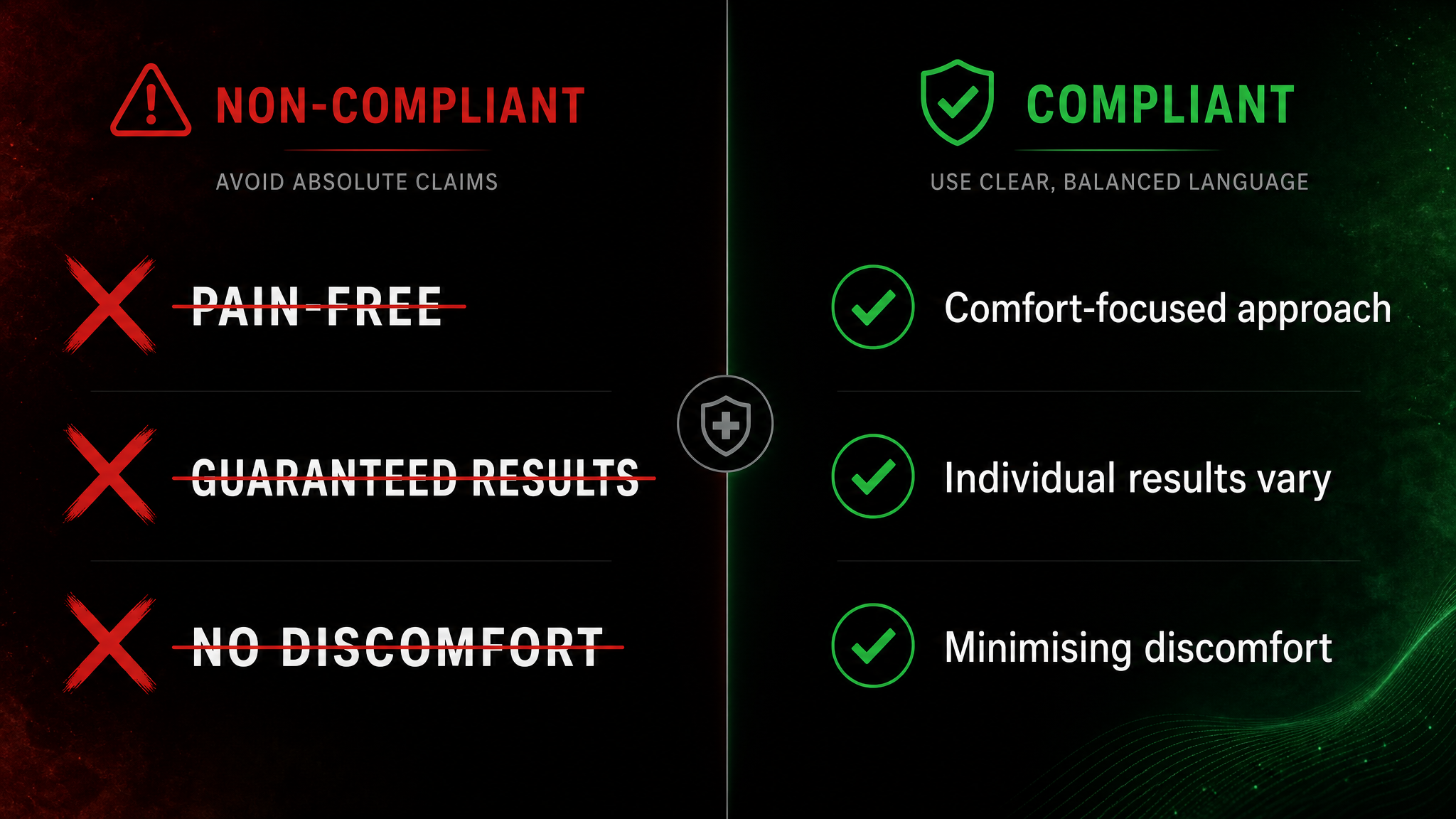
- "We prioritise patient comfort using modern anaesthetic techniques"
- "Our approach focuses on minimising discomfort throughout treatment"
- "We offer sedation options for anxious patients"
- "Gentle techniques designed to reduce treatment discomfort"
- "Most patients report minimal discomfort with our approach"
- "We take every measure to ensure comfortable treatment"
- "Advanced pain management options available"
These compliant alternatives describe clinical approach, available techniques, and patient-reported experiences without creating absolute promises. They acknowledge the practitioner's commitment to comfort while respecting individual variation in pain perception.
The distinction matters legally because AHPRA applies a strict interpretation to outcome guarantees. Unlike some regulatory areas where intent or overall impression determines compliance, guarantee prohibitions focus on the literal presence of absolute language combined with outcome claims.
Do 'pain-free' comfort claims also violate Australian Consumer Law?
Yes. Absolute comfort guarantees can breach Section 18 of the Australian Consumer Law (ACL) prohibiting misleading or deceptive conduct, even if they don't trigger AHPRA penalties. If even one patient experiences discomfort during a procedure advertised as 'pain-free', the claim becomes factually false and potentially misleading, exposing practitioners to ACL penalties reaching $2,500,000 for individuals.
Australian Consumer Law applies a 'dominant impression' test — the overall impression created by advertising matters more than individual statement accuracy. A practice advertising 'pain-free dentistry' creates an expectation that patients will not experience pain. When individual patients do experience discomfort, the advertising has created a misleading impression regardless of how many other patients had comfortable experiences.
The ACL operates independently of AHPRA regulations. A single advertising claim can simultaneously breach:
- AHPRA Guidelines Section 3.2 (prohibited outcome guarantee) — penalties up to $60,000 individual / $120,000 corporate
- Australian Consumer Law Section 18 (misleading or deceptive conduct) — penalties up to $2,500,000 individual / $50,000,000 corporate
- National Law Section 133 (advertising offence creating unreasonable expectation of beneficial treatment) — additional penalties up to $60,000 individual / $120,000 corporate
In plain English, this means a single 'pain-free dentistry' homepage banner could theoretically attract combined penalties exceeding $2,600,000 for an individual practitioner if prosecuted under all applicable frameworks.
The Australian Competition and Consumer Commission (ACCC) has increased healthcare advertising enforcement in recent years. While AHPRA focuses on health-specific advertising standards, the ACCC pursues misleading conduct claims that affect consumer decision-making. Pain-free claims directly influence patient choice — anxious patients specifically seek practitioners promising comfortable experiences, making false comfort claims material to consumer decisions.
In 2024, a Sydney cosmetic injection clinic paid $22,000 in penalties after advertising 'completely pain-free lip filler treatments'. The enforcement action combined AHPRA notification outcomes with an ACCC enforceable undertaking. The clinic was required to remove all absolute comfort claims, publish corrective advertising, and implement staff training on advertising compliance. The practitioner's AHPRA registration received formal cautions that remain on the public register.
How should dental and healthcare practices describe pain management approaches compliantly?
Compliant pain management advertising focuses on clinical techniques, available options, and commitment to comfort without creating outcome guarantees. Describe what you do and what you offer, not what patients will definitely experience. Use qualifiers like 'designed to', 'aims to', 'most patients report', and 'available options' rather than absolute promises.
The compliance framework allows practitioners to discuss pain management as a clinical priority and describe available techniques. What it prohibits is guaranteeing the subjective outcome — the patient's actual pain experience.
Technique Description: "We use modern local anaesthetic techniques and gentle injection methods"
Available Options: "Sedation dentistry available for anxious patients, including oral sedation and IV sedation options"
Clinical Approach: "Our treatment protocols prioritise patient comfort at every stage"
Patient-Reported Experience: "Most patients report feeling minimal discomfort during procedures"
Commitment Statement: "We take every measure to ensure treatment is as comfortable as possible"
Technology Reference: "Advanced rotary endodontic instruments designed to reduce treatment time and discomfort"
Each of these statements describes factual aspects of clinical practice without guaranteeing individual patient experience. They acknowledge the practitioner's commitment and capability while respecting individual variation.
For dental practices specifically, compliant comfort messaging might include:
- Description of topical anaesthetic application before injections
- Explanation of computer-controlled anaesthetic delivery systems
- Details of sedation options with eligibility criteria
- Description of gentle hand-piece technology
- Explanation of treatment pause protocols when patients signal discomfort
- Details of post-operative pain management recommendations
These concrete clinical details provide reassurance to anxious patients while maintaining advertising compliance. They demonstrate competence and commitment without creating prohibited guarantees.
For physiotherapy and manual therapy practices, similar principles apply. Instead of claiming 'pain-free treatment', describe:
- "Graduated pressure techniques adjusted to individual tolerance"
- "Communication-based approach where you control treatment intensity"
- "Gentle mobilisation techniques suitable for acute pain presentations"
- "Treatment modified in real-time based on your feedback"
This approach provides meaningful information about clinical technique while avoiding outcome guarantees. For more guidance on compliant service descriptions, see our article on how to structure service offers compliantly.
What about patient testimonials that mention pain-free experiences?
Patient testimonials are completely prohibited in Australian healthcare advertising under Section 133 of the National Law, regardless of content. Even genuine, unsolicited patient reviews stating 'I experienced no pain' cannot be published, shared, or referenced in any advertising material. This applies to website testimonials, Google reviews visible on your site, social media comments, and video testimonials.
Many practitioners mistakenly believe that genuine patient experiences provide a compliance 'safe harbour' for outcome claims. They reason that if a patient genuinely experienced pain-free treatment and voluntarily shares that experience, republishing it should be permissible. This reasoning is incorrect.
Section 133 of the National Law creates a blanket prohibition on testimonials — in plain English, this means you cannot use ANY patient feedback, reviews, or endorsements in advertising, regardless of how genuine, positive, or unsolicited they are. The prohibition exists because testimonials inherently:
- Create unreasonable expectations that other patients will have identical experiences
- Represent individual outcomes not generalisable to other patients
- May not reflect typical results or experiences
- Can encourage unnecessary use of health services
- Exploit the trust relationship between patient and practitioner
This prohibition extends to third-party platforms. While you cannot control whether patients post Google reviews, you are responsible for not republishing, embedding, or referencing those reviews in your advertising. Specifically:
- Embedding Google review widgets on your website
- Screenshot images of five-star reviews in social media posts
- Quoting patient feedback in website copy, even anonymously
- Video testimonials, even with patient consent and disclaimers
- Before/after images with patient quotes about their experience
- Social media posts thanking patients for positive reviews
- Responding to positive Google reviews in ways that republish the content
For detailed guidance on managing Google reviews compliantly, see our comprehensive guide on Google reviews and AHPRA testimonial prohibitions.
The testimonial prohibition means you cannot use patient statements like "completely pain-free experience" even if they're genuine. You must rely on compliant descriptions of your clinical approach and available techniques rather than patient endorsements of outcomes.
What penalties apply to non-compliant pain-free advertising claims?
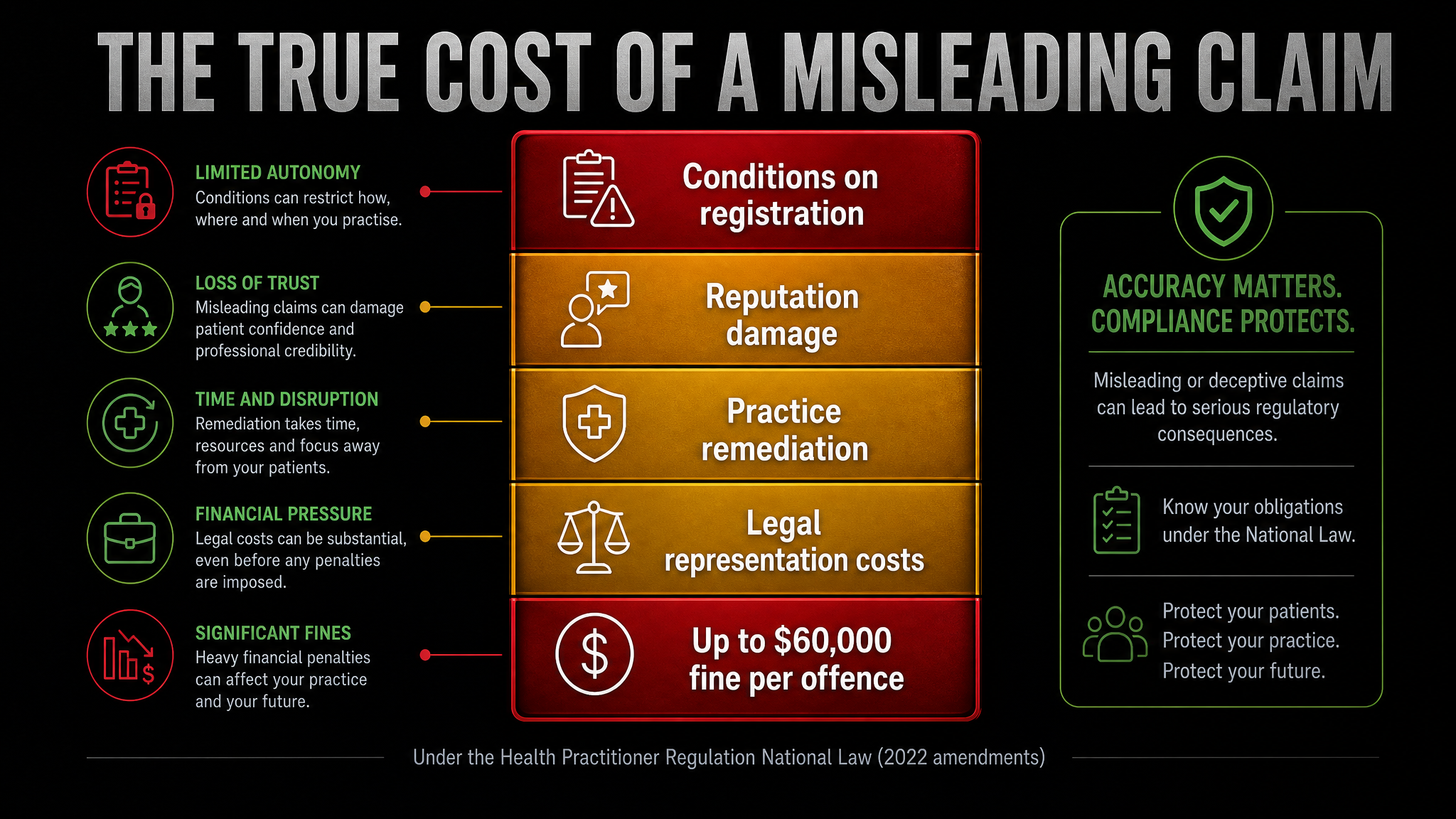
Under the Health Practitioner Regulation National Law (as amended in 2022), individual practitioners face penalties up to $60,000 per offence, and corporate entities face penalties up to $120,000 per offence. Each instance of non-compliant advertising can constitute a separate offence, meaning multiple webpage instances or social media posts can attract multiple penalties.
Under the Health Practitioner Regulation National Law (as amended 2022):
- Individual practitioners: up to $60,000 per offence
- Bodies corporate: up to $120,000 per offence
Source: Health Practitioner Regulation National Law and Other Legislation Amendment Act 2022
The 2022 amendments to the National Law doubled the previous penalty maximums specifically to increase deterrence for advertising breaches. Prior to 2022, penalties were capped at $30,000 individual / $60,000 corporate. The doubling reflects regulatory concern about persistent non-compliance despite enforcement activity.
Beyond direct financial penalties, AHPRA enforcement outcomes can include:
- Formal cautions published on the public AHPRA register, visible to patients and other practitioners
- Conditions on registration requiring advertising pre-approval before publication
- Mandatory compliance training at practitioner expense
- Ongoing monitoring requiring regular compliance reports to AHPRA
- Publication of breach details in AHPRA compliance bulletins and media releases
- Referral to National Boards for professional conduct investigations
For corporate entities operating multiple practitioners, penalties can multiply rapidly. A dental practice with five practitioners advertising 'pain-free dentistry' on their website could face:
- $120,000 corporate penalty for the website advertising
- $60,000 individual penalty for each of five practitioners (if they're individually identified in the advertising or control the advertising content)
- Additional penalties for social media posts, Google Business Profile descriptions, or third-party directory listings repeating the claims
Total exposure could exceed $400,000 for what appeared to be a simple homepage marketing statement.
AHPRA enforcement prioritises advertising that creates unreasonable expectations or guarantees outcomes. Pain-free claims fall squarely within this priority category because they directly influence patient decision-making and create specific expectations about treatment experience.
AHPRA advertising investigations are commonly triggered by:
- Patient complaints — patients who experienced discomfort despite 'pain-free' advertising frequently notify AHPRA
- Competitor notifications — other practitioners report non-compliant advertising by competitors
- Proactive monitoring — AHPRA conducts sector-wide website audits targeting specific advertising issues
- Media coverage — news stories about practices attract regulatory scrutiny of their advertising
- Social media campaigns — viral or promoted content receives higher regulatory visibility
Once an investigation commences, AHPRA reviews all advertising material, not just the specific claim that triggered the notification. Practices under investigation for pain-free claims often face additional findings regarding testimonials, before/after images, or other advertising breaches discovered during the review process.

How should practices audit existing marketing material for non-compliant comfort claims?
Conduct a comprehensive audit of all advertising material — website, social media, Google Business Profile, third-party directories, print materials, and patient communications — searching specifically for absolute qualifier words combined with comfort or pain-related claims. Flag any instance of 'pain-free', 'guaranteed comfort', '100%', 'always', 'never', 'zero pain', or similar absolute language for immediate review and revision.
A systematic compliance audit should cover:
- Website pages: Homepage, service pages, about pages, FAQ sections, blog posts
- Metadata: Page titles, meta descriptions, image alt text
- Social media: Facebook, Instagram, LinkedIn profile descriptions, pinned posts, highlights, story archives
- Google Business Profile: Business description, services descriptions, posts
- Third-party directories: HealthShare, HealthEngine, TrueLocal, industry directories
- Print materials: Brochures, flyers, practice signage, business cards
- Email marketing: Newsletter templates, automated welcome sequences, appointment confirmations
- Video content: YouTube descriptions, video captions, promotional videos
- Paid advertising: Google Ads copy, Facebook ad library content, display advertising
- Patient forms: Consent forms, information sheets, pre-appointment communications
For each advertising instance, apply this compliance test:
- Does it contain absolute qualifier language? (completely, guaranteed, always, never, 100%, zero, absolutely, totally, entirely)
- Does it reference patient experience or treatment outcomes? (pain, comfort, discomfort, results, recovery, healing)
- Does the combination create an unconditional promise? (pain-free = absolute outcome promise)
If all three elements are present, the claim requires revision. Replace absolute language with clinical technique descriptions or qualified statements about approach and available options.
For practices with extensive digital advertising, automated scanning tools can identify high-risk language patterns. Our website compliance scanner specifically flags absolute comfort claims and outcome guarantees across your entire web presence, providing prioritised remediation guidance.
When revising non-compliant content, document:
- Original claim text and location
- Date identified as non-compliant
- Revised compliant alternative
- Date revised content published
- Person responsible for the revision
This documentation demonstrates good-faith compliance efforts if historical advertising becomes subject to AHPRA investigation. While it doesn't eliminate liability for past breaches, it evidences prompt remediation upon identifying issues.
What if competitors are using 'pain-free' advertising — should I report them?
You can notify AHPRA about competitor advertising you believe breaches guidelines, but you are not obligated to do so. AHPRA accepts notifications from any source including practitioners, patients, and members of the public. However, focus your compliance efforts on ensuring your own advertising meets standards rather than monitoring competitors, as AHPRA conducts proactive sector-wide monitoring independent of notifications.
Some practitioners face competitive pressure when local competitors advertise using non-compliant claims like 'pain-free dentistry' or 'guaranteed comfortable treatment'. They worry that maintaining compliant advertising places them at a marketing disadvantage when competitors make stronger (but non-compliant) promises.
This concern is understandable but misplaced for several reasons:
First, AHPRA enforcement is increasing. Practices using non-compliant advertising face growing risk of investigation and penalties. What appears to be a competitive advantage today may result in $60,000+ penalties, published cautions on the AHPRA register, and reputational damage tomorrow.
Second, compliant advertising can be equally effective. Detailed descriptions of clinical techniques, sedation options, and commitment to comfort provide meaningful reassurance to anxious patients without creating prohibited guarantees. Well-crafted compliant messaging demonstrates professionalism and clinical expertise.
Third, non-compliant competitors create enforcement opportunities. AHPRA conducts sector-wide reviews when notifications about specific practices reveal widespread non-compliance patterns. A notification about one dental practice's pain-free claims may trigger an audit of all dental practices in that geographic area, leveling the competitive landscape.
If you choose to notify AHPRA about competitor advertising, you can do so through the AHPRA notifications portal. Provide:
- Specific examples of the advertising (screenshots, URLs, copies of print materials)
- Details of where and when the advertising appeared
- Identification of the specific guideline provisions you believe are breached
- Your contact details (notifications can be made anonymously, but AHPRA may follow up for additional information)
AHPRA treats all notifications confidentially and does not disclose the notification source to the practitioner under investigation.
However, the more strategic approach is ensuring your own compliance is comprehensive and defensible. For practices in competitive markets, consider positioning compliance as a differentiator — "Our advertising meets the highest AHPRA standards" can signal professionalism and trustworthiness to informed patients.
For guidance on compliant advertising across all service types, see our compliance guidance for cosmetic and dental practitioners.
How should practices train staff on advertising compliance for patient communications?
Implement formal advertising compliance training for all staff members who create, approve, or publish any form of patient-facing content, including reception staff posting social media updates, practice managers updating websites, and practitioners writing blog posts or patient information materials. Training should specifically cover prohibited language patterns and require pre-publication review protocols for all advertising material.
Many advertising breaches occur not through deliberate non-compliance but through staff members unaware that routine marketing communications constitute regulated advertising. A receptionist posting a Facebook update, a practice manager updating service descriptions, or a dental assistant responding to Google reviews can all create compliance breaches if they use prohibited language.
Under AHPRA regulations, 'advertising' includes any communication designed to promote health services, regardless of format or channel. This encompasses:
- Social media posts and responses
- Website content updates
- Email newsletters and patient communications
- Google Business Profile posts and updates
- Directory listing descriptions
- Verbal scripts for phone inquiries (if scripted and standardised)
- Signage and in-practice promotional materials
Effective staff training should include:
Core Training Modules:
- What constitutes advertising — definition, examples, scope across all channels
- Prohibited content categories — testimonials, guarantees, superiority claims, before/after image requirements
- High-risk language patterns — absolute qualifiers, outcome promises, comparative claims
- Pre-publication approval protocols — who must review content before publication
- Platform-specific requirements — social media, website, Google Business Profile, email
- Incident reporting — how to report potential compliance issues discovered in existing material
Practical Exercises:
- Review sample social media posts and identify compliance issues
- Rewrite non-compliant service descriptions into compliant alternatives
- Practice responding to patient questions without creating outcome guarantees
Reference Resources:
- Approved language library for common service descriptions
- Prohibited words and phrases list
- Escalation contacts for compliance questions
- Links to AHPRA Advertising Guidelines and practice-specific policies
Training should be mandatory for new staff during onboarding and refreshed annually for all team members. Document training completion with signed acknowledgments that staff understand advertising requirements and pre-publication protocols.
For practices with multiple locations or high staff turnover, consider implementing:
- Centralised content approval — all advertising material reviewed by a designated compliance officer before publication
- Template libraries — pre-approved social media post templates, email newsletter sections, and service descriptions staff can use without additional review
- Automated scanning — tools that flag high-risk language in draft content before publication
- Regular audits — quarterly reviews of published content to identify any non-compliant material that bypassed approval protocols
The investment in staff training and compliance systems is substantially less than the cost of AHPRA penalties and enforcement outcomes. A single $60,000 penalty resulting from a staff member's non-compliant social media post would fund comprehensive compliance training for years.
- AHPRA Advertising Guidelines — Section 3.2 prohibiting guarantees of treatment outcomes, effective March 2020 with ongoing updates
- Health Practitioner Regulation National Law — Section 133 advertising offences, Sections 113-120 protected titles, as amended 2022
- AHPRA Notifications Portal — Process for reporting advertising compliance concerns
Regulations verified current as of 02 June 2026.
This article is for educational purposes only and does not constitute legal or medical advice. Practitioners should consult their legal adviser or AHPRA directly for guidance specific to their circumstances.
Dr Hercules Kollias
AHPRA-registered practitioner · 30 years clinical experience
Founder, The Compliance Scalpel
Dr Kollias built The Compliance Scalpel after three decades of clinical practice — encoding hard-won knowledge of AHPRA and TGA advertising rules into automated compliance tooling for Australian healthcare practitioners.
Check Before You Publish
The Compliance Scalpel audits your healthcare marketing content against AHPRA and TGA guidelines before it goes live. Catch the risks. Cut them out.
Try the Scalpel