Your 'Success Rate' Claims Could Cost $30,000

Reviewed by Dr Hercules Kollias, AHPRA-registered practitioner · 30 years clinical experience
Who this applies to: Fertility specialists, IVF clinics, reproductive endocrinologists, obstetricians offering fertility services, and any AHPRA-registered practitioner advertising assisted reproductive treatments
- Success rate claims create unreasonable expectations under AHPRA Guidelines section 3.6, even when statistically accurate
- Individual practitioners face penalties up to $60,000, corporate practices up to $120,000 per breach
- Comparative claims like "highest success rate" or "above national average" violate section 3.7 prohibitions
- Compliant alternatives focus on process transparency, practitioner qualifications, and individualised consultation without outcome promises
Why are IVF success rates prohibited in advertising?
AHPRA Guidelines section 3.6 prohibits advertising that creates an unreasonable expectation of beneficial treatment. Success rate statistics — even if accurate — cannot account for individual patient factors like age, medical history, or underlying conditions, making them inherently misleading when presented to prospective patients seeking fertility treatment.
The prohibition exists because success rates create a false impression of predictability in highly individualised medical outcomes. A clinic advertising "65% success rate" suggests to a 42-year-old patient with diminished ovarian reserve that she has a 65% chance of success, when her individual probability might be substantially lower. The AHPRA Advertising Guidelines specifically address this issue because consumers cannot verify these claims and lack the clinical expertise to understand their limitations.
Success rates also fail to account for how "success" is defined. Does it mean positive pregnancy test, clinical pregnancy, live birth, or healthy baby at term? A clinic might report success based on embryo transfer while patients assume the figure represents take-home baby rates. This definitional ambiguity compounds the misleading nature of percentage claims.
In plain English: Even truthful statistics about your clinic's outcomes are prohibited because they create expectations that don't reflect what an individual patient can reasonably expect from treatment.
What counts as a success rate claim under AHPRA guidelines?
Any quantified statement about treatment outcomes constitutes a success rate claim, including percentages, ratios, rankings, or comparative statements like "above average results." This extends to implied claims through selective patient stories, cumulative statistics, or visual representations like graphs showing outcome trends over time.
Explicit violations are straightforward: "Our IVF success rate is 58%" or "7 out of 10 patients achieve pregnancy" clearly breach section 3.6. But AHPRA enforcement extends to subtler formulations that create the same expectation of beneficial treatment.
Implied success rate claims include:
- Statements like "most of our patients achieve their family goals" (implies majority success)
- Cumulative statistics such as "we've helped create over 500 families" (suggests high success volume)
- Comparative claims like "results that exceed national benchmarks" (implies superior outcomes)
- Graphs or charts showing pregnancy rates over time, even without specific percentages
- Before/after patient numbers like "started with 200 patients, now supporting 200 families" (implies 100% success)
- Age-stratified outcome data presented as educational content
The test is whether the advertising creates an expectation about the likelihood of treatment success. If a reasonable consumer would interpret your content as indicating probable outcomes, it likely violates the guidelines regardless of how carefully you've worded the claim.
Myth: Publishing success rates is acceptable if you include disclaimers that "individual results may vary" or "past performance doesn't guarantee future results."
Reality: Disclaimers do not cure inherently misleading claims under AHPRA Guidelines section 3.6. The prohibition is absolute — success rate claims create unreasonable expectations regardless of accompanying warnings. AHPRA has consistently found that disclaimers are insufficient to counteract the misleading impression created by outcome statistics.
Can fertility clinics publish ARTG or registry data on their websites?
No. Republishing data from the Australian and New Zealand Assisted Reproduction Database (ANZARD) or other registries still constitutes advertising your services with success rate claims. The source of the data is irrelevant — what matters is that you're using outcome statistics to promote your clinic to prospective patients.
Many fertility clinics mistakenly believe that citing official registry data provides regulatory safe harbor. The reasoning seems logical: if the data comes from a government-recognised source, surely it's acceptable to share it with patients. This assumption is incorrect under AHPRA's framework.
When you republish ANZARD data on your clinic's website or marketing materials, you are selecting that information to include in your advertising. The fact that the underlying statistics are accurate and from a reputable source doesn't change the prohibited nature of the claim. You're still creating an unreasonable expectation of beneficial treatment by presenting success rates to prospective patients.
The distinction is critical: ANZARD publishes aggregated national data for research, policy, and transparency purposes. That public health function differs fundamentally from a commercial clinic using the same data to attract patients. The context transforms factual information into prohibited advertising.
You may, however, direct patients to independent registry websites without republishing the data. A statement like "National IVF outcome data is available through ANZARD at [external link]" provides transparency without creating the expectation that comes from highlighting your clinic's specific statistics.
What about comparative claims like "highest success rate in the region"?
Comparative success claims violate AHPRA Guidelines section 3.7, which prohibits comparisons that could mislead patients about the quality of services. Claims like "leading success rates," "best outcomes," or "above national average" are explicitly prohibited, even if you possess data supporting the comparison.
Section 3.7 addresses comparisons because they compound the misleading effect of success rate claims. Not only do they create unreasonable expectations about your services, they also disparage competitors and suggest a level of superiority that patients cannot independently verify.
Prohibited comparative formulations include:
- "Highest live birth rate in Victoria"
- "Success rates exceeding the national average"
- "Leading fertility outcomes in Australia"
- "More successful than other clinics"
- "Top-ranked IVF centre"
- "Best results for women over 40"
These claims are problematic even with supporting evidence because they mislead consumers about the relevance of aggregate statistics to individual outcomes. A clinic with the "highest success rate" achieved that result with a specific patient cohort that may differ substantially from the prospective patient reading the advertisement.
Comparative claims also create an arms race dynamic where clinics manipulate statistics through patient selection, outcome definitions, or reporting periods to claim superiority. AHPRA's prohibition prevents this race to the bottom in advertising standards.
For more context on how AHPRA evaluates misleading comparative claims across health services, see our analysis of pain-free treatment claims in dental advertising, which involve similar issues of unverifiable superiority statements.
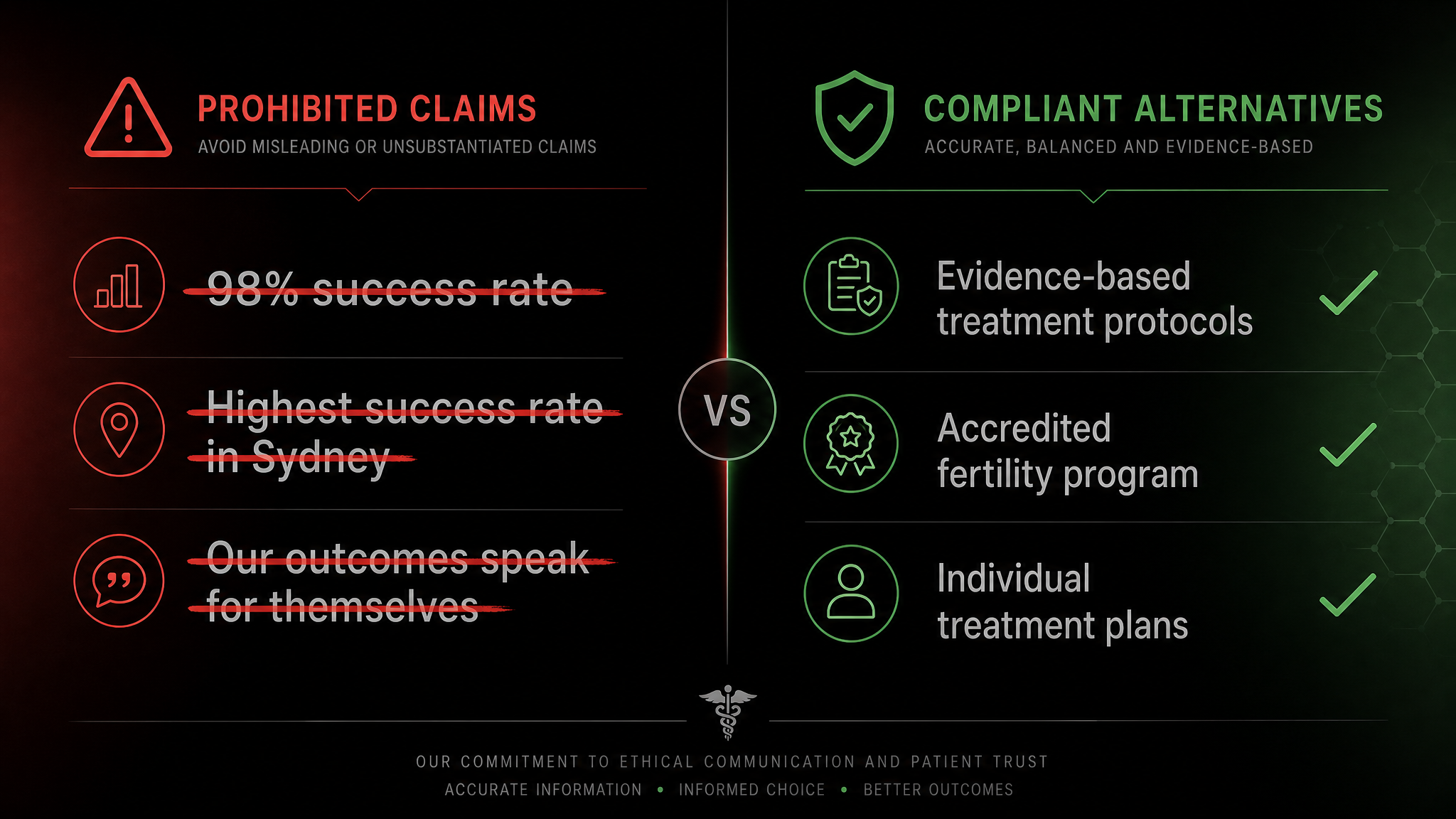
What are compliant alternatives to success rate advertising?
Compliant fertility advertising focuses on process transparency, practitioner qualifications, service descriptions, and patient experience factors without making outcome promises. You can describe your clinical approach, technology, laboratory standards, and support services while directing patients to independent information sources about general IVF outcomes.
The key is shifting from outcome promises to process transparency. Prospective patients want to understand what treatment involves, who will provide their care, and what support they'll receive. You can provide this information without creating unreasonable expectations about results.
Practitioner qualifications and experience:
- "Dr Sarah Chen, fertility specialist with 15 years experience in reproductive endocrinology, AHPRA registration MED0012345"
- "Our embryologists hold ANZICA certification and maintain ongoing professional development"
- "Subspecialist training in recurrent implantation failure and complex cases"
Process and technology descriptions:
- "We use time-lapse embryo imaging technology to monitor development without disturbing embryos"
- "Our laboratory maintains strict quality control protocols consistent with RTAC Code of Practice"
- "Individualised stimulation protocols based on your AMH, antral follicle count, and medical history"
Service scope and patient support:
- "Comprehensive fertility assessment including hormonal profiling, ultrasound, and semen analysis"
- "Access to fertility counselling, financial planning support, and nurse coordinator throughout treatment"
- "We offer single embryo transfer, preimplantation genetic testing, and fertility preservation services"
You can also provide educational content about IVF processes, factors affecting fertility, and what to expect during treatment cycles. Educational content must be genuinely informative rather than disguised outcome claims. Explaining that "success rates vary significantly by age, with maternal age being the strongest predictor of IVF outcomes" is compliant education. Stating "our success rates for women under 35 are 70%" is prohibited advertising.
Directing patients to independent resources is acceptable: "General information about IVF outcomes in Australia is available through ANZARD and the Fertility Society of Australia." This provides transparency without creating clinic-specific expectations.
For guidance on structuring practitioner qualifications in your advertising, see our detailed post on specialist title claims in team bios, which addresses how to accurately represent credentials without overreaching.
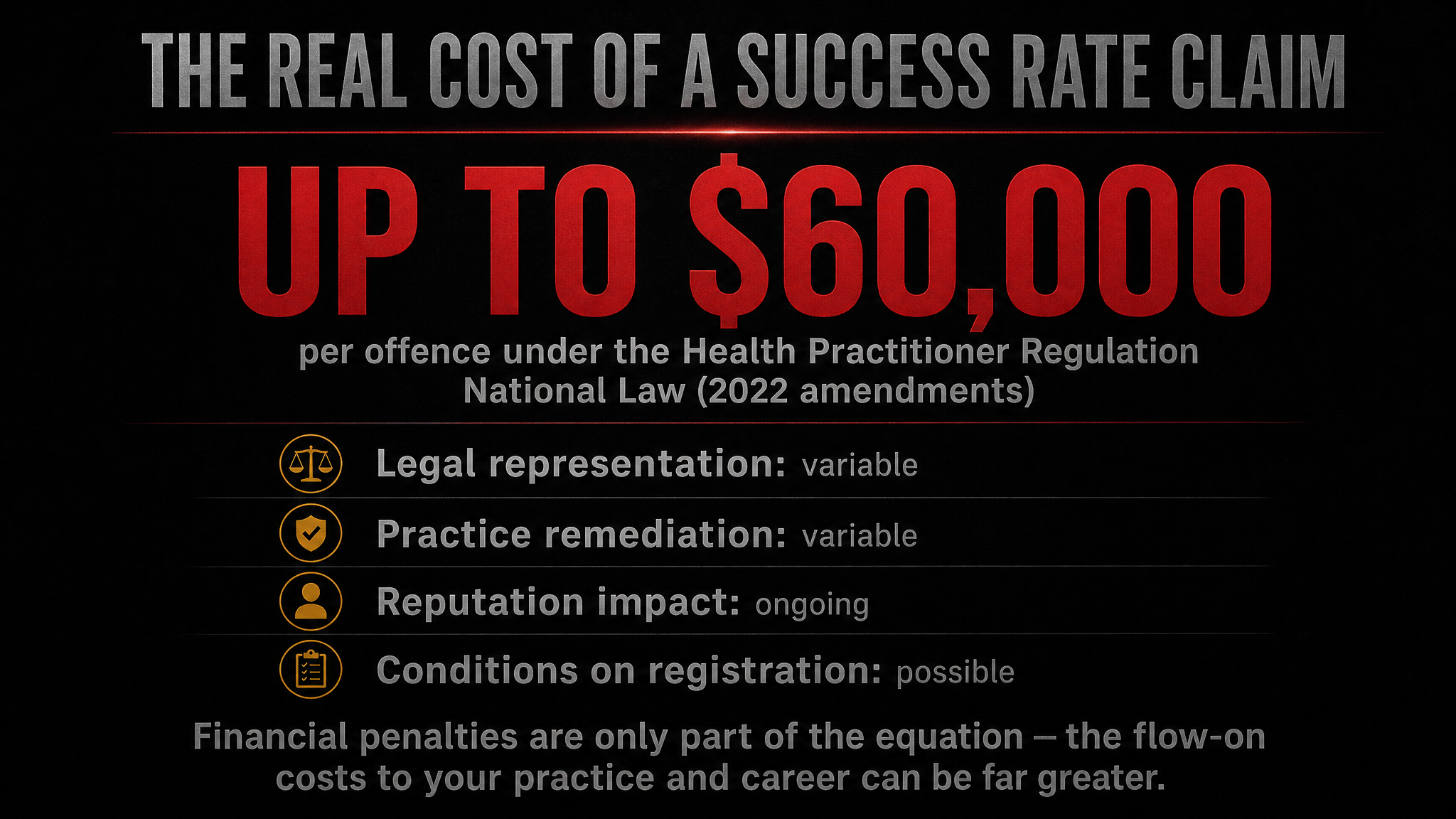
What happens if AHPRA finds success rates on your website?
AHPRA's enforcement process typically begins with a formal notification requiring you to remove non-compliant content within 14 days. Failure to comply escalates to formal investigation, public health risk assessment, and potential prosecution with penalties up to $60,000 for individual practitioners or $120,000 for corporate practices per offence.
The enforcement pathway follows a structured process, though AHPRA may escalate immediately to prosecution for serious or repeated breaches:
Stage 1 — Initial notification: AHPRA issues a breach notification letter identifying the specific advertising content that violates the guidelines. You receive 14 days to remove the content and confirm compliance in writing. Many clinics first learn of their breach at this stage, often after a competitor complaint or routine AHPRA monitoring.
Stage 2 — Formal investigation: If you fail to respond or adequately address the breach, AHPRA opens a formal investigation. This involves comprehensive review of all your advertising across websites, social media, print materials, and third-party platforms. Investigators document every instance of non-compliant content, with each instance potentially constituting a separate offence.
Stage 3 — Compliance action: AHPRA may issue enforceable undertakings requiring you to remove content, conduct compliance audits, implement staff training, and submit to ongoing monitoring. Undertakings become public record on AHPRA's published decisions register, affecting your clinic's reputation.
Stage 4 — Prosecution: Serious breaches or non-compliance with undertakings lead to prosecution in state or territory courts. Courts may impose penalties, injunctions, corrective advertising orders, and adverse costs. Convictions become permanently recorded on your AHPRA registration record.
Under the Health Practitioner Regulation National Law (as amended 2022):
- Individual practitioners: up to $60,000 per offence
- Bodies corporate: up to $120,000 per offence
Source: Health Practitioner Regulation National Law and Other Legislation Amendment Act 2022
The "per offence" structure is critical. If your website contains success rate claims on your homepage, services page, and FAQ section, that's three separate offences. If you've published the same claims across your website, Google Business listing, Facebook page, and printed brochures, each platform constitutes a separate offence. Penalties accumulate rapidly.
Beyond financial penalties, AHPRA breaches carry reputational consequences. Published enforcement decisions appear in search results when prospective patients research your clinic. Professional indemnity insurers may increase premiums or exclude advertising-related claims. Referral sources may distance themselves from clinics with compliance issues.
Understanding AHPRA's broader enforcement approach to prohibited advertising content helps contextualize the seriousness of success rate violations. Our analysis of AHPRA penalties for testimonials demonstrates how seemingly minor compliance oversights trigger significant enforcement action.
How do patients find and choose fertility clinics without success rates?
Patients make informed decisions based on practitioner qualifications, service comprehensiveness, location accessibility, consultation experience, and peer recommendations. Research shows that success rate advertising actually impairs decision-making by oversimplifying complex medical choices and encouraging clinic selection based on misleading statistics rather than individual suitability.
The assumption that patients need success rates to choose fertility services misunderstands healthcare decision-making. Patients evaluate multiple factors when selecting a fertility clinic:
Practitioner expertise and approach: Patients want to understand their doctor's training, experience with cases similar to theirs, and treatment philosophy. Does the practitioner take time to explain options? Do they individualise protocols or use standardised approaches? What's their experience with patients in your age group or with your specific diagnosis?
Service integration and support: Comprehensive care matters more than outcome statistics. Does the clinic offer in-house counselling, genetic counselling, and financial planning? What support is available during the emotional challenges of treatment? How accessible are nurses and coordinators between appointments?
Clinical approach and technology: Patients increasingly research treatment methodologies. Does the clinic use single embryo transfer to reduce multiple pregnancy risks? What embryo selection technologies do they employ? How do they approach difficult cases like recurrent implantation failure?
Practical considerations: Location, appointment availability, communication responsiveness, and financial transparency heavily influence clinic selection. Patients need fertility services that integrate with their work schedules, travel constraints, and financial circumstances.
Consultation experience: The initial consultation provides far more decision-relevant information than any published success rate. Does the practitioner conduct thorough assessment? Do they explain your individual prognosis honestly? Do you feel heard and respected?
Success rate advertising actually undermines informed decision-making by suggesting that patients should select clinics based on aggregate statistics rather than individual suitability. A clinic with high success rates treating predominantly young patients with unexplained infertility may be entirely unsuitable for a 41-year-old with diminished ovarian reserve, yet the published statistics encourage inappropriate selection.
Compliant marketing that focuses on process, qualifications, and patient experience enables better decision-making by helping patients identify clinics aligned with their specific needs rather than chasing misleading outcome promises.
Do success rate prohibitions apply to all fertility advertising channels?
Yes. AHPRA's advertising prohibitions apply to all promotional content regardless of platform: websites, social media, Google Business listings, print materials, radio, television, email marketing, and third-party content you sponsor or control. You remain responsible for content published by marketing agencies, clinic staff, and affiliated practitioners.
The definition of "advertising" under the National Law is deliberately broad. Section 133 applies to any communication that promotes health services to the public, regardless of medium or format. This comprehensive scope prevents clinics from circumventing prohibitions by shifting content between platforms.
Website content: All pages on your clinic website constitute advertising, including "educational" sections, FAQ pages, blog posts, and patient resource libraries. Success rate claims in any of these sections violate section 3.6.
Social media: Instagram posts, Facebook updates, LinkedIn articles, YouTube videos, and TikTok content are advertising when they promote your services. This includes content posted by staff members on personal accounts when identifying their affiliation with your clinic.
Third-party platforms: Your Google Business listing, HealthEngine profile, and directory listings are advertising content you control. Patient reviews on these platforms may constitute testimonials, which are separately prohibited under section 133. See our comprehensive guide to AHPRA testimonial prohibitions for detailed analysis.
Email and SMS marketing: Promotional emails to prospective patients, newsletters, and SMS campaigns are advertising subject to AHPRA guidelines plus additional requirements under the Spam Act 2003.
Print and traditional media: Brochures, newspaper advertisements, magazine features, and radio spots remain subject to the same prohibitions as digital content.
Sponsored content: If you pay influencers, patient advocates, or media outlets to create content promoting your services, you're responsible for ensuring compliance even though you didn't directly create the content.
The multi-platform nature of modern marketing creates multiplication risk. The same success rate claim published across your website, Facebook page, Google listing, and printed brochure constitutes four separate offences, each carrying independent penalties up to $60,000 or $120,000.
Ensuring compliance across all channels requires systematic content governance. Our website compliance scanner helps fertility clinics identify prohibited success rate claims and other violations across their digital presence before AHPRA does.
What should fertility clinics do immediately to ensure compliance?
Conduct a comprehensive audit of all advertising content across every platform, remove any success rate statistics or outcome claims, replace prohibited content with compliant process-focused alternatives, and implement review procedures to prevent future violations. Document all changes and retain records of your compliance efforts.
Immediate action steps for fertility clinics:
- Audit all platforms: Review your website, social media profiles, Google Business listing, directory profiles, email templates, brochures, and any print advertising. Document every instance of success rate claims, comparative statements, or outcome promises.
- Remove prohibited content immediately: Don't wait for comprehensive replacements. Take down success rate claims today to stop ongoing breaches. A temporary gap in content is preferable to continued violations.
- Review patient testimonials: If your website or social media contains patient reviews mentioning successful outcomes, these may constitute prohibited testimonials under section 133. Patient stories describing positive results create the same unreasonable expectations as statistical claims.
- Replace with compliant alternatives: Develop new content focusing on practitioner qualifications, service descriptions, technology and laboratory standards, patient support services, and educational information about fertility treatment processes.
- Train all staff: Ensure everyone who creates or approves marketing content understands AHPRA prohibitions. This includes reception staff managing Google Business listings, nurses posting to social media, and external marketing contractors.
- Implement review procedures: Establish a compliance review process for all new advertising content before publication. Designate a compliance officer responsible for final approval of marketing materials.
- Document compliance efforts: Maintain records of your audit findings, content changes, staff training, and ongoing review procedures. This documentation demonstrates good faith compliance efforts if AHPRA later investigates.
- Monitor ongoing: Schedule quarterly compliance reviews to catch new violations introduced through website updates, social media posts, or staff communications.
For clinics currently under AHPRA investigation or who have received breach notifications, engage a health law specialist immediately. Responding to AHPRA notifications requires careful documentation and legal strategy to minimize penalties and avoid escalation to prosecution.
Prevention is substantially more cost-effective than remediation. The expense of comprehensive compliance auditing and content revision is minimal compared to potential penalties of $60,000 to $120,000 per offence, plus legal costs, reputational damage, and operational disruption from AHPRA investigations.
Understanding the broader context of AHPRA's advertising enforcement helps fertility clinics appreciate the seriousness of compliance obligations. Our analysis of cosmetic surgery advertising guidelines demonstrates AHPRA's increasingly rigorous enforcement approach across specialties involving higher-risk elective procedures.
- AHPRA Advertising Guidelines — Section 3.6 (unreasonable expectations of beneficial treatment) and Section 3.7 (prohibited comparisons), effective March 2020
- Health Practitioner Regulation National Law — Section 133 (advertising offences and penalties), as amended 2022
- AHPRA Notifications and Complaints — Enforcement procedures and compliance pathways
Regulations verified current as of 02 June 2026.
This article is for educational purposes only and does not constitute legal or medical advice. Practitioners should consult their legal adviser or AHPRA directly for guidance specific to their circumstances.
Dr Hercules Kollias
AHPRA-registered practitioner · 30 years clinical experience
Founder, The Compliance Scalpel
Dr Kollias built The Compliance Scalpel after three decades of clinical practice — encoding hard-won knowledge of AHPRA and TGA advertising rules into automated compliance tooling for Australian healthcare practitioners.
Check Before You Publish
The Compliance Scalpel audits your healthcare marketing content against AHPRA and TGA guidelines before it goes live. Catch the risks. Cut them out.
Try the Scalpel